Showing posts with label 1980's. Show all posts

July 16, 2011

Black Butte Tea

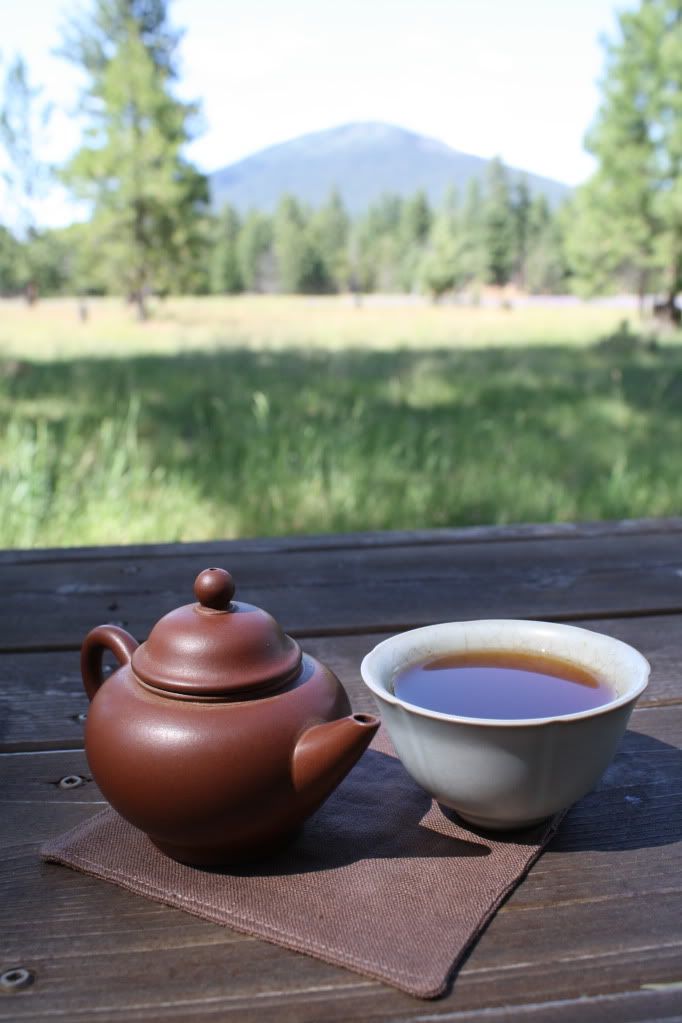
Not the blackest butte I've ever seen.  Please forgive the titular pun.
Or, Tea on Vacation Part II.  This past week I've again been fortunate enough to vacation away from home.  This time I've returned to a time-honored summer haunt for my family--Black Butte Ranch in central Oregon.  It's been a great week full of relaxation, physical recreation (including a scenic climb up the pictured butte), productivity (music for a couple of songs and a handful of textual contributions), and--of course--tea drinking!  As I mentioned but didn't document at the time of our last visit, Black Butte is home to a delightful and accessible spring, from which I've been drawing my tea water for the week.

Perhaps unsurprisingly, it's also been a week of numerous minor tea learning experiences at the mild, reflective pace of a good vacation.  Compared with my last trip, I brought almost everything but the kitchen sink (in terms of tea équipage, that is).  The tetsubin, two yixing pots, a gaiwan, and a dozen or so different types of tea.  Lesson #1: Even on a "fully-equipped" vacation, it's probably still smartest to focus on one tea type, because you probably won't make full use of all the different teas you brought, and you get the benefit of close comparison between different teas of the same genre.  Although I made green tea and a delicious Dong-Ding, I mostly drank aged pu-erh.  If I had left the other teas at home, I could have left the gaiwan and one of the pots, not to mention the tea storage space--ah, the joys of over-packing to avoid silly fear of "not enough variety." 

It was a pretty decadent week, since I usually only drink an aged pu-erh every couple of weeks, but all of the repetition was illuminating.  Firstly, a muted session with an '80's shou/sheng brick reminded me that different weather conditions (it's quite dry here) can affect my sensory faculties and, perhaps, the performance of the tea leaves themselves.  Secondly, the failure of an extremely tight chunk of '80's tuo to fully unfurl reminded me that breaking up large chunks (as gently and possible, even if it's difficult) greatly improves the quality of the session--you don't have to separate individual leaves, but getting the chunk into quarters is significant.  Thirdly, a sublime one-off session with my 1993 7542 reminded me how not all sessions with a single tea are created equal and that there's no shame in the notion that a certain chunk of the cake might be contain a just right combination of leaves, while others may not (Lessons #2-4, respectively).

The final learning experience relates to perspective.  Two years ago--drinking many of the same teas I drank this week, incidentally--I was deliriously eager to try my tetsubin and teas out with mountain spring water.  With a couple more years' experience under my belt, my attitudes to spring water and tea preparation in general have mellowed quite a bit.  Whether it's my rustic palate or my lackadaisical approach, the difference between filtered/Lynnwood spring/Black Butte spring water is not especially apparent to me.  Maybe with some close attention I could tell a difference, but that might spoil the relaxation!  Probably the most enjoyable part of making tea with this spring water is retrieving it--it's really enjoyable to collect the fresh, cold water straight out of the earth and reflect on and feel connected to the elements that come together for a good tea session (definitely nowhere close to the extent that those who are attentive to Chinese elemental tradition do, though).  The water tastes amazing right out of the ground--perfectly cold for a hot day after the bike ride to the spring.  It's also interesting to note that, two years after acquiring the tetsubin and using it with spring water, it still hasn't developed much of a mineral scale/patina at all.  I was really nervous when I first noticed the patina was receding, but now I'm little less anxious; the thing still makes good tea water, and preferable to my other kettles--even to my simpleton's palate.  If anything, I'm wondering whether or not it's really necessary to drive up to Lynnwood to regularly collect water, since the patina hasn't returned.  We'll see after I use up the 10 gallons of water I'm bringing back with me.
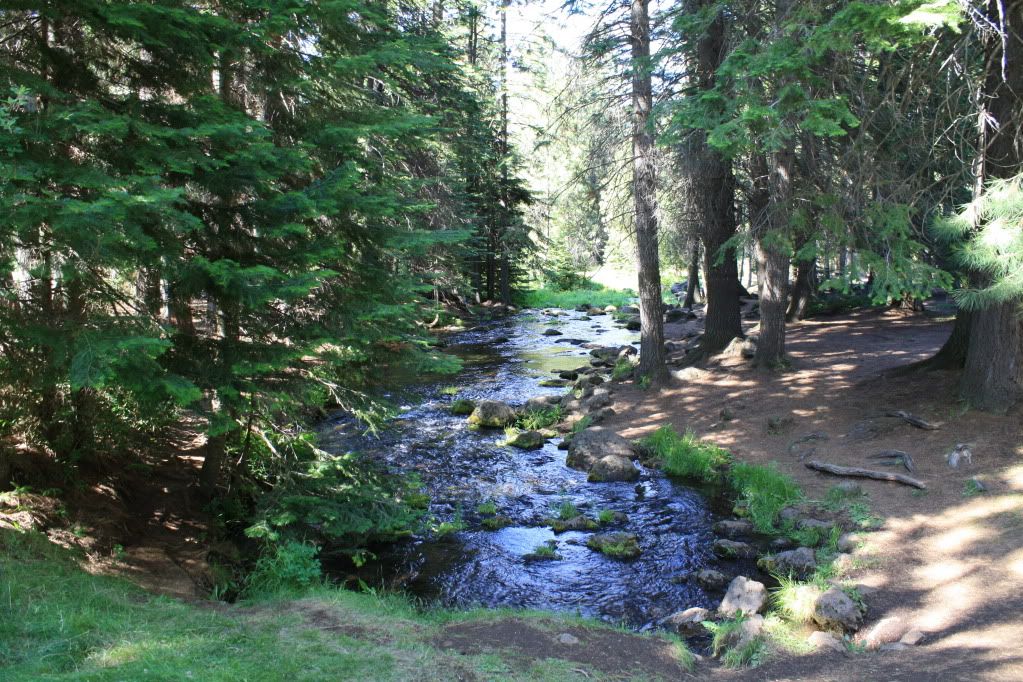
Where'd that come from?

The spring is a great spot--issuing straight out of the ground below where I stood to take this photo and running across the ranch.  There's also a stone bench--a great spot to sit and read, write or quietly enjoy the babbling stream, insects, rodents, birds and wind through the pines.
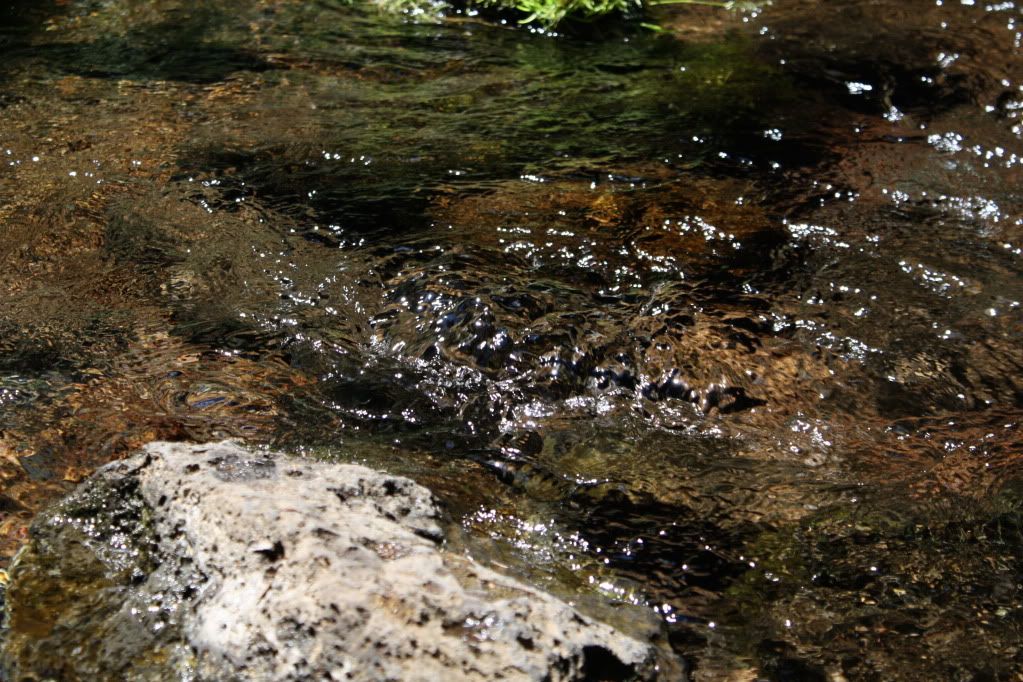
Water mushrooms.

Unlike the Lynnwood spring, which is technically an "artesian well" (meaning that it was originally human-drilled and since then produces water without pumping), this is an honest-to-goodness spring, bubbling straight out of the ground.  While not quite as convenient for jug-filling, it's an invigorating sight to behold.  Here's to drinking tea in the aid of relaxation and contemplation, and to continually learning about it without getting too scientific!

February 24, 2011

Jing Tea Shop 1984 Jia Ji Tuo Cha


It's been a while since I've done a specific tea review, so here's one.  This tea's either still available or now unavailable, depending on where you look on Jing's website ('Rare Teas' for the former, 'Raw Pu-erh Tea' for the latter).  I eyed this tea for quite a while from afar--watching as it sold out and was restocked, wondering if it was worth $1.45/gram.  I try not to nickel and dime too much about these kinds of things, but this tea wasn't available as a per-gram sample, so the stakes were higher.  Obviously I eventually caved under the auspices of the classically pathetic "birthday present to myself." 

This tea is ultimately a bit disappointing, but mostly in relation to its price--I can point with every finger on one hand (maybe some on another) at less expensive teas at Essence of Tea that I prefer to this one.  In brief, this tuo isn't as mature as I'd hope from a 1984 tea, and it's also less complex and less enduring than I've come to expect from aged pu-erh.  Does this all come down to its storage?  Surely, when it comes to maturity and remaining astringency, but when it comes to complexity and endurance I really have no idea.  A more humid might transform the flavor with a little more depth, but then again the original source material might just not have the complexity found in more famous blend bings.

Really, though, a few years ago this would have been the best aged pu-erh I'd ever tried--the drier storage does bring out a sweetness that for some reason always reminds me of blackberry bushes.  It's quite sweet and soft in the mouth barring a little astringency, and it does survive more brews than an unaged pu-erh.  If this were the only aged pu-erh I'd invested in, I'd probably be pretty upset.  As it stands, it's a rather expensive addition to my modest stash of aged tea that I'll be able to occasionally dip into in order to take the pressure off the better stuff.  I suppose part of the expense goes toward the reminder that not all aged teas are good, and that years aren't always an accurate measure of maturity.

June 6, 2010

1985 Loose Menghai 8582 & The Mandarin's Tea Room

This afternoon I had a nice session with this 80's Menghai 8582 pu-erh from The Mandarin's Tea Room. Tim has been blogging for several years, but only recently started selling tea. I'm far from the first to write about his teas, and I'm sure plenty of you out there have already been attracted by his shop's alluring-looking teas and hyperbolic prices. Like you, I've been interested since the site went up but only recently did I take the plunge and order 5g each of this tea and the 80's brick, as well as some of the 2009 high-fired Anxi Tieguanyin.

My time with this tea was very pleasant. The loose leaves show the spectrum of aged pu-erh colors, from dark brown to more of a rusty red for the buds and yellowed leaves, and there are enough white specks to indicate some period of humid storage. My 5g sample was quite loose--not really any chunks to speak of, which makes me wonder when this tea was last in cake form, and why it was broken up (assuming it's been broken up since before Tim bought it). Brewing loose pu-erhs takes a bit more attention; since the leaves are all already separate, the flavor and essence of the leaves comes out a bit quicker and I have to adjust my tried-and-true brewing parameters a bit and be swift pouring off the rinse.

The aroma is rich, perfect for these final damp spring days, and each brew fills the cup with thick darkness topped with swirling mist. I've tried enough Menghai pu-erhs of this vintage that experiencing this tea isn't a revelation, but more of a very happy comfort. As with most aged pu-erh, the mouth feel is a main attraction--smooth as the day is long, though there's a tiny trace of astringency that some more aging could probably take care of. Likewise, the flavor is well-developed and mature, but as the steeping times first start increasing there's a vanishing hint of bitterness. When a tea's character is so full, though, it's hard to fault it for exhibiting the last vestiges of its youth--if I owned a cake of this tea, I doubt I'd be telling myself "Wait 5-10 more years, then it'll be fully mature." If anything, a fleeting whisper of youth only adds complexity to an aged tea--more important to my palate is that the aged characteristics outweigh the youthful ones, and there's no contest here. I'd also note that this tea's flavor seems to exhibit more high notes, maybe more acidity than other aged 8582's I've tried, which is a welcome addition to its complexity--clearly I'm not even close to having this recipe mastered! Although there are better values out there for sampling, I'd confidently add this tea to the short list of "good" aged pu-erh options if you're unfamiliar with the genre and want to gain a better understanding of the baffling relationship between young and old pu-erh.


I also have to mention the packaging (pictured above), which seems to be designed more with NYC residents in mind rather than seasoned tea drinkers. Yes, my 5g of 8582 really did come in a glass vial with a cork stopper. The ornate tag describes the tea. The glass vial came in a white box (along with my other 5g sample, in its own vial, of course) sealed with a sticker that reads "Pure Premium of the Choicest China Teas...Superior Quality Leaves." The white box was in turn wrapped in tissue paper, which was sealed with another special sticker, and a separate embossed card details brewing instructions for the tea. I acknowledge and want to be respectful of the effort that's gone into selecting and providing these quality teas, but to me this kind of packaging is over the top and arguably wasteful. I appreciate the impact of an attractive and classy look when it comes to branding, but so much extra material and frill seems designed to either attract people who don't know enough about tea to be attracted by the teas' virtues themselves, or to make the rather "NYC" prices seem to be more "worth it." The second option is a little ironic, considering the fact that the expense of the custom stickers, cards and multiple individual wrappings is only driving the prices up more. If there were a "No fancy wrappings, please, just tea in bags adequate for storage" option on the site's checkout, I'd gladly select it, but instead I'm feeling guilty about instigating the waste. However, I give Tim credit for so completely conceptualizing the look of his product and not compromising on presentation--it's just not my style!

Unfortunately I don't have enough time these days to individually review all of the teas from this purchase, I will say that the 2009 high-fired Tieguanyin is my top pick. The tea's sumptuously complex, easily the best of the few fired Anxi Tieguanyins I've tried, and I've been surprised at how vibrant the high notes and acidity are. I'd venture to say that the tea's flavor profile is the closest thing to Taiwan's Muzha Tieguanyin I've tasted from the mainland, and that Tim's tea is close to being as good as the great Muzha TGY currently offered on Hou De, though neither are inexpensive. As always, all quibbles aside, I'm thankful for the opportunity to try such good teas.

May 23, 2010

Early 80's Da Ye

This tea (pictured R, below a thorny intruder!) can be had from Essence of Tea (formerly NadaCha) for a mere £750/350g bing. Even with the GBP taking a beating like it's taking right now, this tea's price is daunting. Luckily, it's also available by the gram, and for an achievable investment a pot's worth can be yours. I'm not here to ramble or moan about the price of teas--I feel that this goes on way too much on too many tea blogs for my tastes. When a certain level of quality is assured, price is far from the forefront of my mind as a factor of interest. Instead, knowing from plenty of experience that the quality of Essence of Tea's offerings has satisfied me many times (with only a few exceptions), this tea's price indicates that it's what Asian collectors (probably Taiwanese) view as "the good stuff" from its time period--this tea is a learning experience waiting to happen.

For me, the chance to ponder so many questions when tasting a tea like this is partly what makes it worth the price of admission: How does a $1000 aged cake taste? How should a pu-erh taste after almost 30 years of aging? More specifically, what does a Menghai 8582 recipe (this is supposedly an earlier prototype of that now famous recipe) taste after decades of aging? What kinds of characteristics in aged teas are sought out by collectors? When you're trying some of your first aged tea, the answers to these questions become the entire universe of your experience, but the more teas you try, the broader your knowledge becomes and the more you can start asking other questions: How is this different from other aged teas I've tried? How mature does it taste compared with contemporary productions? How much less mature does an 80's tea taste from a 70's tea? Is it more worth purchasing a tea of this price and maturity or a less expensive, less mature tea in hopes that it will reach a state similar to this tea? The list goes on and on. I have a very small amount of experience with teas like this, but I can imagine that even those with a host of experience with contemporary pu-erhs and beyond still have plenty of questions to probe with every tea they try.

5g in the pot and a quick rinse. With teas of which I own whole cakes, I may use 6 or more grams for a session, depending on how the tea is apt to behave. I'm a little worried that my decision to buy only 5g may result in a weak pot, but the ensuing session quickly disabuses me of that notion. Most of my experience with 8582 recipes older than 10 years has given me the impression of light, thinner sweetness--less of the directness and high notes that you'd find in an aged 7542, and maybe even a little less of a distinct character. Not that this is necessarily a bad thing--I'd be happy to have some of these aged 8582 cakes in my collection, but I can't say they'd be my favorites. This one is rather different, though, with a thicker mouthfeel, darker cup color and something of a bolder flavor. I probably shouldn't compare it too directly to other 8582's, since it's a prototype and it's made from wild trees instead of plantation bushes.

The tea's broad, sweet and cooling, but there's also a hint of something edgy--I can't tell if it's some vestiges of youth or just a facet of the tea's flavor. This is the point where I wish I had three or four pots' worth of this tea so I could decide whether or not that specific flavor is something I enjoy or dislike. Around the tenth infusion I'll be damned if I didn't taste--for a fleeting second--some sort of tropical fruitiness, something I'd never expect from a pu-erh. The surprisingly dark color of the liquor persists through probably about 15 infusions, at which time the flavor turns to that generic stewed-aged-pu-erh taste. Sweet, smooth and drinkable, but with very little of a distinct character left. I know a lot of people like to continue steeping the tea over and over at this point, but I prefer just 2 or 3 long steeps, maybe 20 minutes at the most, and call it a day--overnight steeped pu-erh just doesn't taste great the next day when it's at room temperature. Overall, this tea was quite enjoyable to drink. I've just written a lot here about studying and learning from aged pu-erhs, but ultimately I'm in it for the enjoyment and mellow buzz of drinking a good aged pu-erh. I'm not always ready to spend $20 on one pot of tea, but with the offerings from Essence of Tea I'm confident it'll be worth it. I always recommend that enthusiasts of young sheng pu-erh try at least a few old ones if they think they're collecting with the intention of fully aging tea--how can you decide a tea is good for aging if you don't know what good aged tea tastes like? I probably wouldn't start with a tea as expensive as this one, though. Something like the 1993 7542 will set you back about $5 for a pot, which seems to be a reasonable price for the pleasure and learning that can be had with a tea like that.


The leaves certainly live up to the cake's moniker and reputation as 8582 predecessor--they are big. A bit of prodding reveals that some of the used leaves are much softer, suppler and lighter brown than others, which is interesting. There's a lot of zealotry happening online these days about so-called questionable processing practices in today's pu-erhs--namely over-oxidation and "improper" kill-green--but teas like this seem to me to be a gentle reminder that a) pu-erh processing is a much larger and more complex subject than some of us would like to believe, and b) a lot of aged teas that are valued by Asian collectors and are also tasting pretty delicious exhibit evidence of some of the processing characteristics that are being decried as foul play. In situations like this, agnosticism seems to be the most prudent position, rather than setting yourself up for some serious foot-in-mouth action. To be fair, though, it's a lot easier to say a certain processing technique is "ok" when you're holding a delicious, obviously successfully-aged cake in your hands. What to buy, when you want to eventually have a tasty home-aged cake? Familiar dilemmas persist.

February 27, 2010

Big Fun with Three Liu An Teas

I've been on a real late 60's/early 70's Miles Davis kick lately--the spacey Big Fun was a perfect companion to the head trip I received from tasting three different Liu An teas this afternoon.

Liu An is a tea about which I have a lot of questions. You don't see it very often online, and I've seen it variously lumped in with green tea, pu-erh tea and black (hei) tea (i.e. Liu Bao). I've heard it's pan-fired like green tea, but I've also heard it's cooked like Liu Bao or shu pu-erh. Since it's nowhere near as popular as pu-erh, there's very little consolidated information to be had. In cases like this, it's usually best to learn what you can with your mouth (and other senses, of course).

I got ahold of 3 Liu An samples--none is purported to be less that 10 years old. Starting on the left we have a 1999 Liu An from Yunnan Sourcing, a 1995 Sun Yi Shun Liu An from Hou De (this tea has been sold out for a very long time; I received a sample in a recent tea swap), and a 1980's Sun Yi Shun Liu An from Essence of Tea.

What really prompted this comparison (besides the fact that I haven't really reviewed any teas on here for a while) is that I recently received the '99 sample and, after trying it once or twice thought, "this is pretty good, it seems nearly as aged-tasting as the '80's tea from Essence of Tea." The only way to really know for sure is to try them all.

Of the three teas, the '99 example is the exception in most ways--the leaf profile appears larger than the other two, it's not really compressed (though that's probably just from being broken up for sampling), and the flavor and aroma are distinct from the other two teas. After a quick rinse I smelled the leaves--a rather crayon-y wet clay smell--I decided to give another rinse! A bit more of a tea smell this time, but still that strange earthy clay note, which I don't remember from the other times I've tried this tea. A few rather long steeps later (I only used 3g since I was doing a handful of teas) and I've got the impressions I need--tartness, a receding hint of grass cut too soon after the rain, a wee bit of bitterness, and a touch of musty storage taste. Not bad, and certainly a hell of a lot tastier than the youngest Liu An (2004) I've tried, which I would consider totally undrinkable. After about the second sip I was already feeling the qi all over my face, washing back and forth across my eyes. Two more teas to go, yikes!

The '95 example's appearance evidences a bit more humidity in the storage--a frosty coating on the leaves, and a pleasant (to me!) musty aroma. The aged Liu An teas I've tried remind me of very specific basements from my life--I think the strength of this sense/memory connection is part of what makes me return to these teas almost compulsively. The flavor of the '95 is pretty different--actually more bitterness, with more of a storage taste and with a thicker mouthfeel and much darker, richer liquor. This tea tastes like it needs more time in the same way that a 15 year-old pu-erh does when the bitterness is one of the only youthful characteristics left. Enjoyable--when I use up the last 5 grams I think I'll be giving shorter steeps which should bring out more sweetness and a very pleasant all-around session. This tea tastes a lot more aged than the '99, but actually not a ton younger than the '80's tea, aside from the bitterness.

I've had several sessions with the '80's Liu An from Nada Cha/Essence of Tea, and I've enjoyed every one of them. If not for that tea, my Liu An impressions would have ended with the 2004 tea I tried. The storage taste is reminiscent of the '95 tea but different, perhaps because of more age or perhaps because of the particulars of where they were stored. The bitterness is actually present still if the brew sits, but it's less assertive than the younger tea. Body is great, and the tea gets sweeter in the ensuing brews--almost as good as an aged pu-erh, but definitely different. Eventually it gives up the same kind of sweet stewed taste that comes from long steeps of aged sheng pu-erh. I wonder how much of the similarity between the '95 and the '80's teas comes from the fact that they're both Sun Yi Shun Liu An, whereas the younger tea is not.


A gander at the wet leaves does little to alleviate questions about the processing of Liu An--the '99 looks like a mix of "cooked" and raw leaves, the '95 looks quite uncooked, and the '80's looks either mixed, storage-darkened or (likely) both. Interesting--after dumping out the '95 leaves I was just certain that the '99's processing meant it could never turn out like the two older teas, but then the '80's tea looks cooked and tastes more like the '95. At $26.10/450g basket, the '99 isn't a very expensive gamble so I think I'll be seeing what happens with at least one basket. I'd be interested to know the original price of the '95 Hou De tea for the purposes of value hypotheses. The '80's tea is expensive, but less so than its sheng pu-erh contemporaries, and I think a better value than some. To return to the original impetus for this comparison, I have to conclude that the '99 tea really isn't close to being in the same league aging-wise as the '80's tea, or even the '95 tea. A candidate for aging, perhaps, but not a fully mature tea.

By the time I finished with the '80's tea my head was swimming so much I decided to sit down for a few minutes and just relax--I haven't been so qi drunk in quite a while. Luckily a bit of food settled things down. Drinking aged tea can feel so different! If you've tried aged sheng but not Liu An I recommend sampling the '80's tea for a similar but distinct experience. Time to try and find some other Liu An teas to try.

September 4, 2009

1980's Xiaguan 8653 Traditional Characters


I'm back here for comparatively regular posting, with this aged Xiaguan pu-erh from NadaCha. Nada fulfills what seems to be a sadly unique niche in the online western tea vendor community--he sells aged pu-erh (along with authentic antique teaware and personally-sourced and produced pu-erh and other teas) at reasonable prices. If only there were more like-minded vendors, we'd probably all know a lot more about aged pu-erh.

Today is the fifth time I've had a chance to experience this tea, and I'm thankful I've had so many experiences with it, because they've all been great learning opportunities. At the original time of this tea's listing on the NadaCha website, it was far and away the most expensive tea offered at a whopping £355. Since then, it's been soundly trumped by a couple of £750 early 80's Menghai cakes, but that's another story. The point is, this cake presents a chance to try an aged classic blend from a popular factory. The price also gives us a glimpse of what the aged pu-erh market is looking like these days--to me, $600 for one cake of pu-erh skirts the upper limit of what I could ever imagine being a reasonable purchase, and $1300 is just too much. I'm more than happy, though, to part with a smaller amount of cash to understand just what it is about these aged brand name teas that has facilitated such a pricey market.

Extremely tightly-compressed leaves (check out the cloth print in the picture) have clearly aged to a darker brown, and the large portion of buds has turned mostly orange. After a quick rinse and a generous first steep, the ironbound chunk of leaves gives off a pleasant and complex aroma--honeyed wood, to be boring and general, and to be more specific, sharp mustard and a basement in Richland, WA that I haven't visited in well over 15 years. Smell, of all the senses, wins hands-down for having the strongest ties with memory. After comparing a number of young, mid-aged, and aged pu-erhs with each other, I'll tremblingly submit that the "mustard" aroma I've mentioned in several notes just may be the combination of a tea's diminishing smokiness and its increasing aged flavor. Taste of the liquor mimics the aroma's complexity, though I confess I'm not experienced enough with Xiaguan teas to identify the "unmistakable Xiaguan taste."


It takes a good four infusions before the chunks start to loosen up, which I admit annoys me. By the fifth (pictured), the inner leaves have opened up, but the outer leaves are several infusions ahead. I'm also suspicious that the ridiculous compression accounts for my least favorite aspects of the drinking experience: For my most recent sample, after just a couple of infusions, this tea is dry, dry, dry. I'm also suspicious that this is because the leaves on the inside of the cake haven't aged as much because they've received much less exposure to air and humidity, thanks to their compression. Therefore it seems reasonable that the product description describes a tea free from astringency--a sample from the thinner, looser edge of the cake probably isn't astringent at all. The other aspect I'm not as pumped about is the rather prominent smoky flavor that is surprisingly still present in the leaves. It took me a few sessions to put my finger on it, especially because I had already convinced myself that no tea this old could possibly still taste smoky, but it's there.

It might well be that I really have convinced myself--for me, a tea this old and this expensive really should taste more mature. With aged pu-erh, it's not as easily possible as it is with brand new pu-erh to buy cakes and cakes, willy-nilly--if I'm going to pay for a whole cake of old pu-erh, which is never a cost to scoff at (even if it's a good value), I want it to taste old, even if it's flawed. This cake is complex with a great hui gan in the aftertaste, and its considerable aging progress is undeniable, but it also tastes like it still needs more aging before it's really a pleasure to drink as an old cake. For this price, a "project" cake isn't worth it to me, even if it's a good one. Mostly, this is because I'm still unsure as to the quality of climate where I live in terms of pu-erh aging effectiveness. Since this cake appears to have aged slowly even in Taiwan, there's a small possibility it could never become truly "aged" in the traditional way in my climate. Hypothetical bummer. If I collected tea in Taiwan, this tea's price might make more sense to me--I could hold on to it for a few more years and have a fantastic cake. But part of me still wants to say, "Come on, how long should it really take for a pu-erh to reach reasonable maturity?" Xiaguan knows 100% more than I do about actually creating pu-erh tea, but to me this level of compression seems unhelpful. Who knows, though, it could be the cake's past storage as well. Safe to say it's time for me to bow my head and quit pretending like I know anything about the "why" of pu-erh production and aging. All I've got a handle on is my senses, and they've decided that, as an old pu-erh drinking experience, this cake is not as good of a value as a number of other teas offered on the site, like the blended bricks, the Xiaguan tuocha, and the loose Wang Zi pu-erhs. Alternately, if you're looking for a "project" tea that's going to need a few more years, the Grand Yellow Label cake, the 8582, and the early 2000's cakes generally offer lower prices.

Anyone else try this tea? I'd be interested in reading someone else's opinion, especially since it took me so many sessions to really form mine. Thanks to Nada, as always, for offering these teas--even if you don't fall in love with a tea, it's always a valuable experience to try them.