Showing posts with label Storage. Show all posts

March 3, 2011

Dipping into the Stash

I recently made the somewhat difficult decision to open a large canister of oolong I'd been planning to age.  It's a 2008 Traditional Shui Xian from Jing Tea Shop, and I've been storing it for just about a year myself with hopes of opening it much later and enjoying a delightful aged yan cha (right?).  The present question is, why open it instead of continuing to age it?


From what I've experienced, there seem to be three different types of aged yan cha.  First is the well-roasted type that tastes overly of charcoal when it's first processed.  Impatient me, I usually enjoy and drink these types of tea regularly without aging, but have also had numerous examples of three to five year-old teas that taste really nice.  The charcoal aspect seems to lose its sharpness and ease off into a more rounded, mellow darkness.  I wouldn't really consider these teas aged--more "set-aside" to balance the flavors and become ideal for drinking.  For the most part, they still taste like young yan cha.  The second kind of aged yan cha is the well-aged, old variety.  Here we're talking much older, definitely more than 10 years and upwards of 15 or 20.  These teas don't taste much like young yan cha at all.  They're more like other aged (usually Taiwanese) oolongs--plummy, mellow, sweet, and without as strong a tea taste.  If they were heavily roasted when they were young, they're usually full of dark flavor notes, and if they were less roasted then they tend to have more shifting, sometimes sour high notes.  I'd venture to call this the ideal for aged yan cha.  The third type of aged tea is more of an odd duck--I've tasted teas of this stripe that were supposedly from the 90's, and I've tasted teas that taste eerily similar that range from five to only a couple of years old.  They generally don't taste like young yan cha (not much of a charcoal note at all) but they don't taste like the other aged yan cha.  The flavor is vaguely plummy and a bit aged, but not usually as complex as the second type.  There's nothing wrong with this type of aged tea, but from the ones I've had, they all taste pretty similar to each other and none have been as satisfying as an "ideal," a "set-aside" or just a good new yan cha.  My experiences are pretty limited, so this type may be what's considered standard aged yan cha, so maybe I'm getting it wrong, but I'm really hoping that not very many of the teas I've set aside turn out this way.
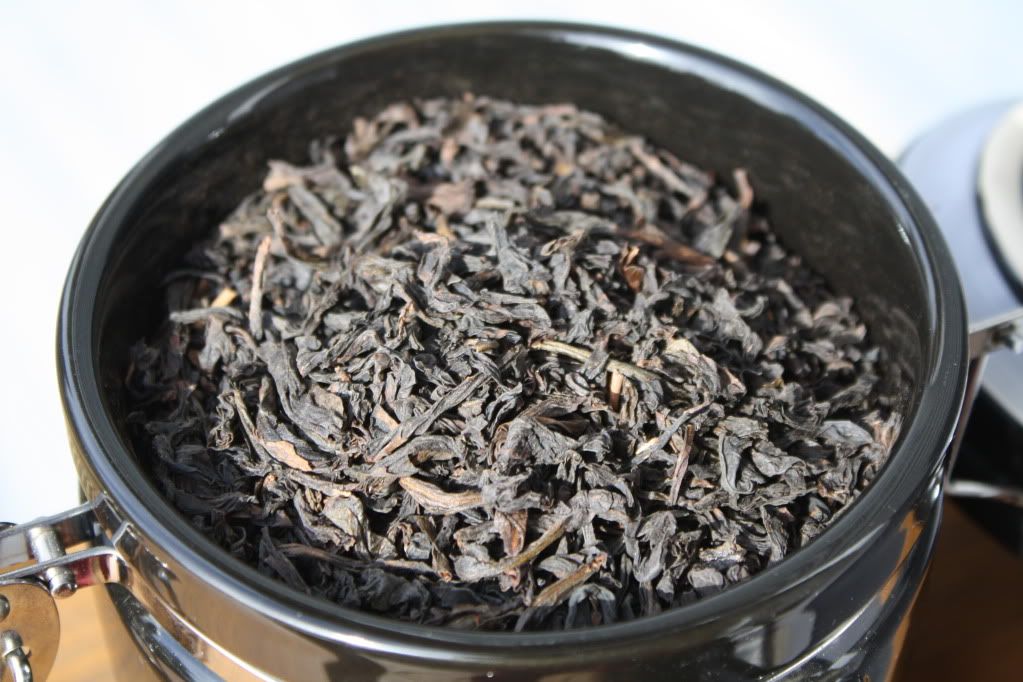

This brings me back to the tea I've just reopened.  When I chose to age some of it a year ago I did so based on the fact that I really enjoyed drinking it--though it's a very reasonably-priced tea ($7/oz, I think) it has the roast level, body and flavor/aroma I look for in an everyday yan cha.  I've since had a bit of trouble finding teas like this to drink regularly, let alone age.  In the meantime I've been trying a number of "aged" teas of the third variety that make me worry for my aging experiments.  If this tea were to turn out like those, I'd end up with a passable but not excellent aged tea that I would have enjoyed much more in its youth.  It seems like it's probably better to leave the aging risk to the other teas I've set aside that aren't quite as high on my "ideal to drink now" list.  If they don't turn out fantastic, at least I won't have lost the chance to drink them when I would have enjoyed them most.  After a year's home storage, this tea is still tasting really nice.  It's still a bit drier than the 2010 Traditional Shui Xian, but it still has the nice creamy mouthfeel that its younger counterpart has in even more abundance.  Its roast is pretty high, if not the highest I've had, which puts it in the first category, which is probably the one I prefer most on a daily basis--it's a tea that's been set aside for a few years and it's reached an ideal balance but still tastes like new yan cha.

This last point touches on an interesting lesson I have to continually remind myself about.  That is, you always have to ask yourself why you're aging a tea.  Is it an experiment--can my aged tea taste as good as the one I bought that was aged by somebody else?  Is it because the tea is shitty and you're hoping the aging process will turn it into something worth drinking?  I've got a couple of those.  Is it because you prefer the aged version of the tea and aren't interested in the young one?  That's basically my stance on young sheng pu-erh, which I appreciate but rarely drink for enjoyment.  When I buy young sheng, it's purely for the sake of aging--the main risk is that it won't age.  If you buy something with the intention of aging it but actually love it just how it is now, you could find yourself wishing you drank it when it tasted how you liked it.  It's easy to get caught up in the "aged is better" attitude but you'll always benefit if you're realistic about your tastes.  I drink aged oolongs casually and occasionally, so why should I commit a huge amount of tea to aging when I'd enjoy it more now, even if it turns into a good aged tea?  No sense incurring "ager's remorse"!

March 18, 2010

A storage experiment

.

I had a fun little time yesterday breaking up a couple cakes for storage in some recently-purchased yixing containers. Though I've heard from a number of online retailers that you can store pu-erh in yixing jars, it wasn't until recently that I heard a couple of really intriguing accounts about the specific effects that just a few months' storage in clay jars can have on pu-erh: the tea will become rounder, smoother, and a lot mellower in flavor, I'm told. Now that I think about it and have had another look, I have to give Bret at Tea Goober credit for mentioning this a long time ago--sometimes I have to hear things from a few sources before the skeptic in me can be persuaded, though. Plus, I hadn't actually had someone explain to me until recently the exact effects of yixing jar storage.

The yixing jars come from Golden Teahouse. It's been a while since I've ordered from them, but they had the best prices I could find on smallish yixing canisters. As it turns out, they're actually pretty small. I didn't measure precisely, but they're probably only 300 ml at the most. It's not too big of a deal, though--it just means I don't have to invest as much tea to fill up the container! Also interestingly, although I ordered 2 of the same product, the jars have slightly different clay colors: one is more on the purple side and the other is redder.

To fill the jars I used the Zhong Cha Big Leaf 90's bing and the 90's unwrapped brick from my Skip4Tea purchase. The main reason I got all excited for this experiment is because the supposed effects of yixing storage are exactly what I want for these two teas--I don't consider either of them mature yet, and they both have enough harshness that they aren't especially pleasant to drink. If the jars can accelerate the aging in the short term and take the edge off the bitterness (and hopefully the smokiness, especially in the case of the brick), then these teas could become pretty good everyday pu-erhs without waiting several years. Since I'm not overly enamored with them, it won't break my heart if the experiment doesn't produce life-changing results. The really fun part is that I've still got plenty of each original cake left over, so comparison will be easy. I think 3 months is a reasonable time frame, so we'll check back then. Anybody out there have any experience with yixing pu-erh storage in the short term, or more interestingly, the long term?

If this works out well, I've got a few teas I'm more excited about that could use a little aging acceleration--it would be nice to have a few more teas in the rotation so I'm not drinking up the expensive stuff quite as fast! For now, the thing I'm most excited about isn't tea but--you guessed it--music. Maurice Ravel's Daphnis et Chloé has been bouncing around my brain, speakers and headphones the past week. I'm attending a performance at the Seattle Symphony tomorrow night and I don't think there's another piece of classical music I'd be more excited to hear live (ok, maybe Gershwin's Rhapsody in Blue, but Daphnis et Chloé is longer, and it's got a full choir for goodness' sake!). Ravel is often overshadowed by Debussy when it comes to the impressionist music movement of the early 1900's, but for my money it doesn't get any better than Ravel's ballet--that swelling crescendo and the whole Lent section has got to be 4 of the most gorgeous minutes in music history, as far as I'm concerned (my neck is tingling just thinking about it). It's a shame how many people could sing John Williams' Star Wars, Indiana Jones, and Jurassic Park themes from memory but have never heard one of the pieces from which he has continuously borrowed so heavily in all its glory. *Ahem,* Tea! (Maybe I need to start another blog...)

As for the blossoms, it's hard to believe how early spring came this year in Seattle; probably about a month earlier. Reminds me of the almost laughably melodramatic "The Birds" from Peter Hammill's solo debut Fool's Mate. There was much better work to come...despite the fact this early spring brought blossoms too early for Chinese greens, the weather has at least remained nice enough that the blossoms have lingered awhile without being hailed off of their trees.

March 20, 2009

1999 Menghai 7352 from Jing Tea Shop

I...might've glid before...

More sheng pu-erh! This is a sample of Menghai's 7352 recipe purchased from Jing Tea Shop. It dates from 1999 and, according to its brief description, it's 'dry stored,' which could mean any number of things. Perhaps more informatively, it's been dry stored in Guangdong province, China, which we can assume means something different from 'it's been dry stored in Phoenix, Arizona,' probably in a good way. There's so much debate online about the proper storage of aging pu-erh, especially from a humidity perspective, that this tea is even more interesting to try from an academic perspective. Most of the aged pu-erh I've had the opportunity to try has been supplied via Taiwan, which comes with certain biases regarding ideal flavor, storage, which cakes achieve popularity amongst the booming afficionado market etc., so it's especially informative to receive a more diverse example. Considering the cupboard I've got full of pu-erh cakes, I'm already invested in this debate, so it's with bated breath that I try and learn just how dry and cool a storage environment can be without destroying a cake's chances of aging. I consider this cake a key piece of information in the spectrum of different storage styles and conditions.

The leaves of the sample are already well-separated, which doesn't really bother me (as long as they're not powdered), though I probably prefer larger chunks. They're still looking pretty young, but not excessively so--they're darkening and looking just a bit frosted. Rinsed in the pot, the aroma has that dusty sweetness that I have come to lovingly associate with the few delicious dry-stored aged pu-erhs I've had the privilege to enjoy. The leaf aroma also betrays a healthy remnant of smokiness. I'm happy that it appears to be diminishing, leading me to wonder how many more years until it's gone completely.

This tea is in a transitory phase between the young, raw characteristics I'm very familiar with, and the aged maturity that is less readily available in quantity. Somebody in one of the Art of Tea magazines said that teas of this maturity aren't fun to drink, but I have to disagree--if the aging characteristics were only very slight, I might concur, but here it's really straddling the line, which I find quite pleasant. I have to admit that I have found myself a bit bummed that some of my favorite characteristics found in young sheng have been nowhere to be found in some of the aged pu-erhs I've tried, and it's nice to taste that light, airy quality that makes the tea very active in the mouth. The first couple of infusions are healthily bitter, but the bitterness recedes and partially sweetens in the aftertaste. The liquor's color surely shows the aging progress, and that mist on top of the cup is always fun to take in. The smoke is quite subdued in the flavor, and what's more prominent is a mushroomy, sweet wood flavor that sweetens more with air and as the tea cools. Astringency is still potent, though pleasant--could be my proclivity for yen cha, but I don't mind a bit of saliva when I'm drinking tea (as long as it's my own). The aroma in my tea pitcher is definitely less engaging than the last tea I tasted, leaning toward the smoky and sharp side, kind of an emphasis on that mustardy smell I mentioned in the last notes. Interestingly enough, the final, long and mellowing infusions are where this tea's aged qualities become most pronounced and a thicker musty sweetness becomes the dominant flavor. I don't know anything about this blend (it seems not to be one of the very top blends from Menghai) but this tea drinking experience is on a really promising track.

If the aging of this tea continues the way it has, I could see it being really dynamite in another 10 years--no more smoke, no astringency, and no bitterness, and it would be just like that delicious 80's 7542 ching bing that Hou De used to have samples of. From a personal perspective, since this tea has very definite aging progress and very definite room to complete its maturity, I should be able to monitor its progress (or lack thereof) fairly accurately as I try to determine firsthand whether or not pu-erh can actually be aged in the Pacific Northwest's climate, or if I should stop buying young pu-erh. Let the hand-wringing continue.