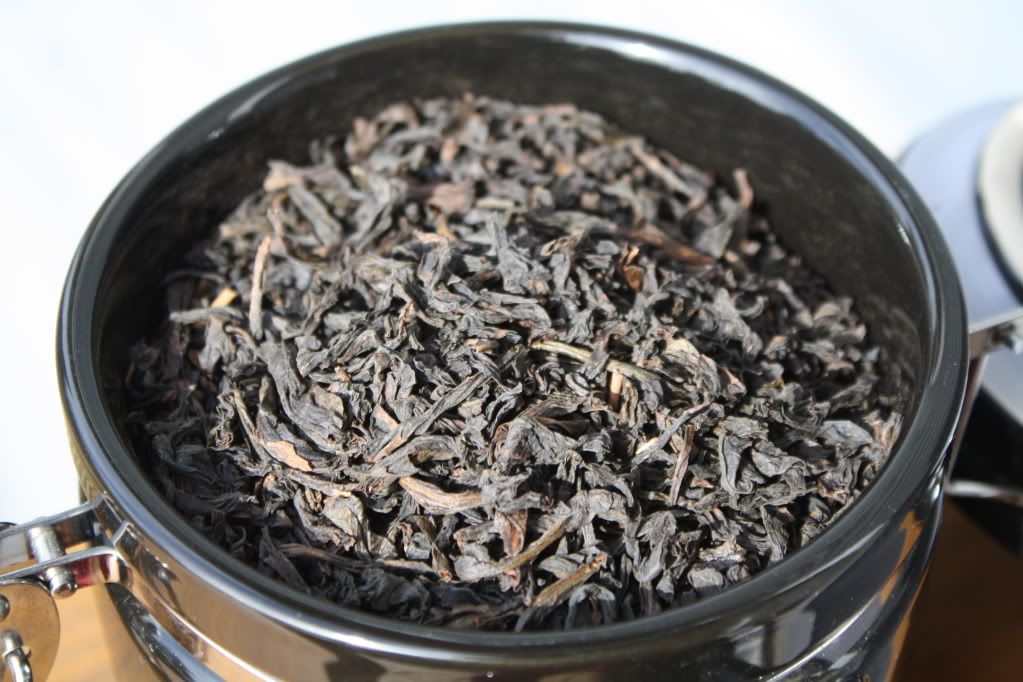
Ok, so that's not what trifecta means, but it sounds cool, so sometimes I use it to describe three of something. Bai Ji Guan means white cockscomb, which is that thing on a rooster's head, and it's one of the Si Da Ming Cong, or the four famous Yen Cha cultivars (the others being Da Hong Pao, Shui Jin Gui, and Tie Luo Han). There are a few things that are almost always said when describing Bai Ji Guan, so I'll get them out of the way in attempts to avoid dwelling on the same old same old. The first is that the tea gets its name from a legend about a rooster that died protecting its chicks, or some such story, or that the tea is so named because its leaves actually resemble a rooster's crest. Tea naming legends don't really interest me very much, though the physical appearance of Bai Ji Guan's leaves is quite striking in comparison with other teas--they are generally a much paler yellow, are rather small and almost seem a little more translucent. The second thing that people
always seem to mention when describing Bai Ji Guan is that it's the rarest of the Si Da Ming Cong.
Seven Cups offers more information than most regarding
why this is (the cultivar's touchiness to growing and climate conditions and the sensitive and limited harvest window), but most vendors are content to leave it at "rare." From personal experience, Bai Ji Guan
is quite rare insofar as its availability to the West is concerned; few online sellers even offer a Bai Ji Guan, and if they do it's usually quite expensive. It's also pretty difficult to find more than the cursory information I've already mentioned and few bloggers have posted experiences about the tea.
Why the Bai Ji Guan obsession?
Hou De used to sell a Bai Ji Guan from 2004; I encountered it near the beginning of my blossoming passion for yen cha (a little less than a year ago) and was blown away by its flavor--different from every other yen cha I've tried, with a vibrant fruity/floral acidity that floated lightly over the tea's obviously skillful roasting job. Well, Hou De eventually sold out of the tea and, though I've got a bit tucked away, I've been on a search for more of the same ever since. The catch is, though, I have yet to encounter another Bai Ji Guan that is even processed in the same manner, let alone as high-quality. In some ways, my Bai Ji Guan quest is the ultimate microcosm of my intentions with this blog--my quest to find more Bai Ji Guan has also been a quest to understand what exactly the characteristics of authentic Bai Ji Guan are, and how and where I can get more of the one that caught my taste buds. Unfortunately my attempts to prolong the magic have thus far been thwarted--of four other Bai Ji Guans I've tried, none have even come close to the style of Hou De's. I have, however, learned quite a bit about what seem to be the tea's hallmark characteristics. Here I'd like to humbly share what little I've learned from my attempts, in case you've heard of Bai Ji Guan but haven't wanted to shell out the big bucks to try it. Tasting notes for three examples follow.


The well-informed and generous staff at
Seven Cups were kind enough to include samples of both their
2007 Bai Ji Guan and their
2008 Bai Ji Guan with a recent order. Before I launch into my notes and impressions, I'll say that the difference between Hou De's Bai Ji Guan and every single other one I've tried (including one from
Teaspring) has been roasting--all the others have been comparatively extremely lightly roasted, which imparts a totally different flavor and aroma. As I inspected the greenish brown leaves of Seven Cups' 2007 tea, I immediately knew I wasn't going to find my elusive tea, but I eagerly anticipated a chance to try another piece of the puzzle. Please forgive the quality of the pictures--clouds make for dull natural light, so the colors aren't quite as vibrant as they appear to the naked eye, but flashes are so harsh. The leaves are complete but small (especially for yen cha). A common denominator I've noticed with all examples I've tried is that the dry leaves are two-toned--one dark and one lighter and yellowish. As you can see in both pictures, they're a delight to behold and I could personally spend hours inspecting the delightful intricacies of each leaf.

After a few experiences, I've learned to brew Bai Ji Guan differently from other yen cha. Usually I'll stuff the pot over half full with leaves and flash infuse the teas for the first four infusions, increasing by 10-15 seconds on each later infusion. This tea's lighter roasting changes the rules, though, and that much leaf just makes the tea too strong in an unpleasant way (unlike the strength of a heavier-roasted yen cha, which I find pleasant, if quite powerful). So, as I try to understand this tea's needs I've had better results with about a one third-full pot and a slightly longer first infusion (15 or so seconds), dropping down to 5ish for the next few, then climbing back up as taste determines. I wish I could go in-depth with this 2007 tea, but unfortunately the results were pretty disappointing. Brewed with my trusty yen cha setup (zhuni pot and celadon pitcher and cup), the aroma and flavor were familiar and immediately recognizable as kindred to the other light-roast Bai Ji Guans I've tried. It's got a totally unique oolong flavor, and there's really little to know noticeable relationship to your average yen cha. You might as well be drinking alien tea, but please don't ask me what alien tea tastes like (I am not at liberty to either confirm or disconfirm the existence of alien tea). There's a savory vegetal aroma that immediately emanates from the leaves, offering a light honeysuckle sweetness that is immediately accessible. In some ways this tea is reminiscent of green tea in aroma and flavor, but with an oolong's body, complexity and longevity. Sadly, my experience with Seven Cups' 2007 example didn't go so hot--the first infusion confirmed my expectations for the tea and gave me enough information to say "Yep, it's Bai Ji Guan," but the flavor seemed shy. Though this isn't uncommon in first infusions, the tea never really increased in potency as the session wore on--insipidity came on pretty quickly (around the 4th or 5th go) and a several minute infusion even failed to produce much flavor. I'm wholeheartedly open to the prospect that my preparation of the tea could be the cause for these results, but I've prepared similar examples (including Seven Cups 2008 tea) in the same fashion with completely different (and successful results). Depending on storage conditions, 2 years could be just a little too long for this lightly-roasted tea, and I respectfully submit that this tea might be past its "sell by" date, especially considering the fact that $38/25g raises customer expectations considerably. Despite the tea's diminished power, it's still fun to take a look at the cashed leaves--I've noticed that the leaves often display widely varying color and oxidation, ranging from dark green leaves to pale, almost yellow ones, and the oxidation is always beautiful and easy to spot. If only the tea were a bit fresher.


Happily,

Seven Cups' 2008 Bai Ji Guan fared much better compared to the previous year's harvest. According to the web site, the tea received a slightly higher roasting to prevent any grassy taste from the weather conditions on the day of harvest. Though the leaves are pretty similar in appearance, you can tell the difference in comparison of both photos (as well as in the liquor, which is a few shades darker). Even more so, the aroma and flavor betray the roasting. The same sweet, flowery and honeyed notes are there, but are complemented by the bewitching darker, woodier roasting element that only caramelized the floral aspects of the lighter-roasted version. In the flavor, the roast takes on a really pleasant chocolate-like sweetness. Though I drink a lot of yen cha, I don't tend to liken their darker aspects to chocolate, but here the description seems pretty direct. Like other fresh Bai Ji Guans I've tried, this one goes on and on, taking shorter infusions at the beginning with gentle results and yeilding up thinning but minutely evolving flavor with longer later infusions. Despite the longer infusions, the tea's astringency is neither unpleasant nor powerful, which is a plus. Unfortunately I didn't get a chance to photograph the spent leaves; though the first tea's flavor was weak, its caffeine apparently wasn't! By the time I finished both teas, I was levelled by caffeine and fled desperately in search of food and plain water. Needless to say, I was much more impressed with this example than the first, and I liked it enough to flirt with the idea of purchasing some, though I'll have to think it through a bit more, considering the price is similar to the 2007 tea.

Finally, we have
Jing Tea Shop's
2008 Bai Ji Guan. Though this tea comes from 2008, its roasting seems to be lighter than Seven Cups'.

Since I shelled out $78 for 100g of this tea, it is the Bai Ji Guan with which I've had the most experience. Unfortunately this included burning up a few pots' worth of tea with bad brewing parameters and mistakes. Expensive education! Thankfully, though, this experience allowed me a little more confidence in preparing my one-shot samples from Seven Cups. Though this tea didn't recapture my elusive Hou De lark, it is quite a pleasant tea to drink. Thick, syrupy liquor with plenty of flowery honey and an almost tingly mouthfeel. As pictured, the liquor resembles that of the first tea, though a bit darker because of the cup's depth (as Captain Beyond lurks above, awaiting play at the Stepping Stone's vinyl night).

Like some others I've tried, it does seem to march on indefinitely above 10 infusions, which is certainly a plus. Usually I get worn out before the tea does! Astringency is again present, but in appropriate quantity and quality. The flavor of this tea is unique and pleasant, but as far as gong fu brewing goes, it's not especially dynamic, that is to say it doesn't make a whole lot of evolution flavor and aroma-wise throughout a session. So, at its premium price, I'm not sure I'll be rushing out to buy 100 more grams anytime soon, if I even go through my tea very quickly. Thankfully, Jing Tea Shop also offers 25g samples at a reasonably increased fraction of the 100g cost (reasonably priced samples of every tea is one of my favorite things about Jing Tea Shop, which is one of my go-to vendors for Chinese oolongs, greens, and sometimes pu-erh).

Overall, tasting these teas has been a very educational if not wholly satisfying pursuit. Though Bai Ji Guan is unique in flavor, I'm not sure the price is justified for my tastes. Today I actually dug out the remainder of the sample I purchased from Teaspring--if it compares favorably to Jing's (which in my memory it does) I might say that you should try Teaspring's instead of Jing's if you're curious, since it is considerably less expensive. Stay tuned for that update, if you're interested. I now feel like I've got a decent handle on what light-roast Bai Ji Guan is supposed to taste like. If (as according to Seven Cups) the tea is actually traditionally lightly-roasted, I suppose I can appreciate the tea's traditional processing, but I still yearn for the experience I've had with Hou De's 2004 Bai Ji Guan (I'll review a bit of my final stash in the future). The hunt continues.