Let me preface these reviews by pleading Stéphane to forgive me for taking an inexcusable amount of time to write up my tasting notes for these teas that he kindly donated for review! I've mentioned how busy I've been these past three months, but it's really not much of a justification. I've been in hermit mode--working hard, trying to save money, not drinking much tea, and I've even retrogressed musically, mostly listening to a playlist of albums I haven't listened to in over a year--what started at 4500 songs is now threatening to drop below 1000. Maybe I should try that with my pu-erh stash! So, my relaxation time has been devoted to "pure" relaxation activities rather than constructive ones like rhapsodizing about the sensory delights of tea. Time to make amends a bit.
If you've found your way to my seedy, unkempt corner of the tea blogosphere, then you're already well familiar with Stéphane's blog,
Tea Masters, and the varied, high-quality and multilingual content he's been posting for years. Stéphane actually contacted me after a
music- and Tea Masters-related post and offered some samples. We had a nice exchange of emails that resulted in some oolongs and pu-erh winging their way to me--Stéphane wanted to know what I thought of his pu-erh because I write about it so often. Also, and more unusually, he sent me 6g of his 1990 Hong Shui oolong (at the time retailing for $18/6g) on orders that I should "pay what I think it's worth." Tasting these teas was fun.
The festivities started with two unaged hong shui oolongs. Direct comparison seems simultaneously appropriate (since they're both hong shui) and inappropriate (since they're from different years, seasons and growing regions), but here goes. Of the two, the
fall 2009 tea was darker in character--more of a roasted aroma, more fruity notes, and more of a cereal character--but somehow a greener liquor. The
spring 2010 tea, on the other hand, did seem to have more of a
gaoshan character, with a more lingering aftertaste, fuller mouthfeel, and somehow a redder liquor. The leaves weren't in the best shape but were clearly hand-harvested. I've had a number of hong shui oolongs in the past year--probably over 10, come to think of it. They seem pretty popular right now, at least in the Western tea market. Although there have only been a few that I'd consider buying quantities of, I like what the tea represents--higher oxidation, a bit of roasting, and an emphasis on more than just aroma. I've also noticed a wide variation in how much oxidation and roasting are employed to make a hong shui--these fall into the majority category (medium oxidation and light roasting), but I've seen a few that are more like black (red) teas.
Next was a
2010 spring Alishan soft stem oolong. One of my online tea buddies was subtly ribbing me for not drinking much gaoshan oolong--we all have our tastes, I guess, and mine usually favor something with at least medium roasting. If a gaoshan oolong is good, though, I always leave the session wishing I felt like drinking gaoshan more often. High mountain oolongs are one of those tea types where, for me, it's less about comparing minute differences between mountains and harvests and more about whether the tea "has it," that is, if it displays the level of characteristics it should for being the type of tea it is--I'd rather drink no gaoshan oolong than mediocre gaoshan. This Alishan fit the bill; refined, subtle, floral and just a touch fruity. The leaves were soft without any harsh texture, and the infusions rode the edge of bitterness on the first couple infusions, gently tapering into fruity squash sweetness. Satisfying.
The younger pu-erh (whose URL I can't seem to find) is Stéphane's fave, a 2006 Lincang. I fear I may have given an inaccurate impression of my drinking habits--though I do love pu-erh, I know very little about the different growing regions, factories, recipes etc. Although pu-erh's one of my top tea types, it's still another tea where I try to find a tea that "has it." For pu-erh, usually "it" is a certain amount of agedness, since drinking aged pu-erh provides an experience I haven't found in any other tea type. I do dabble in younger pu-erh from time to time, though, and this Lincang was a reminder of how such dabblance (new word I made up, what do you think?) can be pretty rewarding. This tea tastes a bit more aged than the other 2006 teas I've been recently drinking, with a character that tends more toward the hearty rather than the high and sweet. I'm not really in the market for 2006 pu-erh, so it's hard to say whether I'd buy this or not if I were. Like a lot of semi-aged pu-erh it's beginning an awkward adolescence but has enough going for it that it's still enjoyable to drink.
The second pu-erh is a
loose 1970's sheng. This tea definitely fall in the "has it" category--I think my sample was 2.5g, and it was sufficient for over 10 steepings in a 100ml pot. Gentle, vibrant and well-aged. I don't have too much else to say about this one, other than that it fits the bill of what I look for in aged pu-erh; just a nice relaxing drinking experience with enough complex flavor to keep things interesting--leaves were pretty complete with some twigs. For the price, you could probably get a better deal, but this was a good pu-erh.
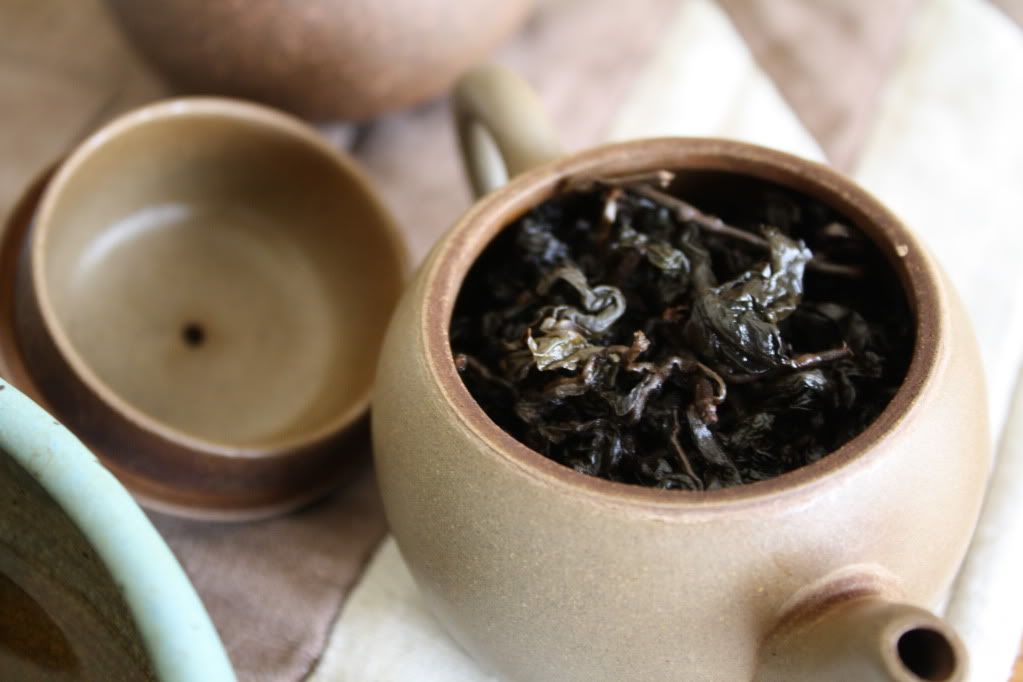
Finally, we have the 1990 aged hong shui. This was the tea I'd been anticipating the most, both because of the price and because I'd read a number of Stéphane's posts about it. I'm gradually being convinced that aged oolong is a viable tea genre, and this tea was another item of evidence contributing to that conclusion. Dark leaves, loosely rolled. A bit of hot water sets free a grainy aroma and commences an entirely enjoyable session. This tea lasted a valiant number of steepings, considering it's getting rather long in the tooth, and the initial 5-8 were full of robust complexity that gradually became simpler as the infusion times lengthened. I eventually steeped this tea for 10+ minutes at a time and was interested to try it next to an aged Fo Shou oolong that was at a similar place steeping-wise. Though they were both steeped-out, the hong shui had a much more medicinal character than the fo shou, which was still very floral/fruity. It would be interesting (if impossible) to see how one of the other hong shui oolongs from this group tastes in 20 years compared to how this one tastes now. It's hard to imagine they'd be very similar, but who knows? As far as deciding how much this tea is worth, I think $18 would be a reasonable price if I sat down in a nice tea house and ordered it off the menu; the quality of this tea is as good as the better aged oolongs I've tried, and simply having the experience of tasting a tea like this is worth the price now and again. I would definitely not be trying to stock my tea cabinet at this price (or even rushing to order another 6g), but for a one-off experience (like going to the movies or a concert) an $18 treat is permissible. Luckily, Stéphane's reputation is well-supported so spending the money on one of his more expensive teas isn't much of a risk.
To wrap up, I'll mention the brewing suggestions Stéphane made. One of my favorite things about Tea Masters is that it's as much about the details of
brewing tea as it is about the teas themselves. Stéphane recommended using a gaiwan and told me the samples would be small in order to illustrate that it's possible to get more out of less tea. I couldn't agree more. When it comes to yan cha or charcoal roasted Taiwan oolong, I'll generally load the pot sot it's completely packed when wet. When it comes to gaoshan oolong and young pu-erh, though, I'll use much less--usually a scant covering of the bottom of the pot, or slightly more than the bottom of a gaiwan. I don't really enjoy much bitterness or aggressiveness in highly floral oolong, so 3-4g/100ml usually does the trick. When the samples arrived, I was excited to see that Stéphane's leaf allocation was pretty close to what I would choose, though I might pile on a pinch more leaf for the more oxidized oolongs. As for the gaiwan/yixing dilemma, I think it's a style thing--I'm happy to use a gaiwan for testing teas but I'll probably always be thinking in the back of my mind how the tea could be seasoning one of my pots. Good tea tastes good no matter what. Thanks Stéphane!