Showing posts with label Pot Profile. Show all posts

September 19, 2011

Roasted Dancong


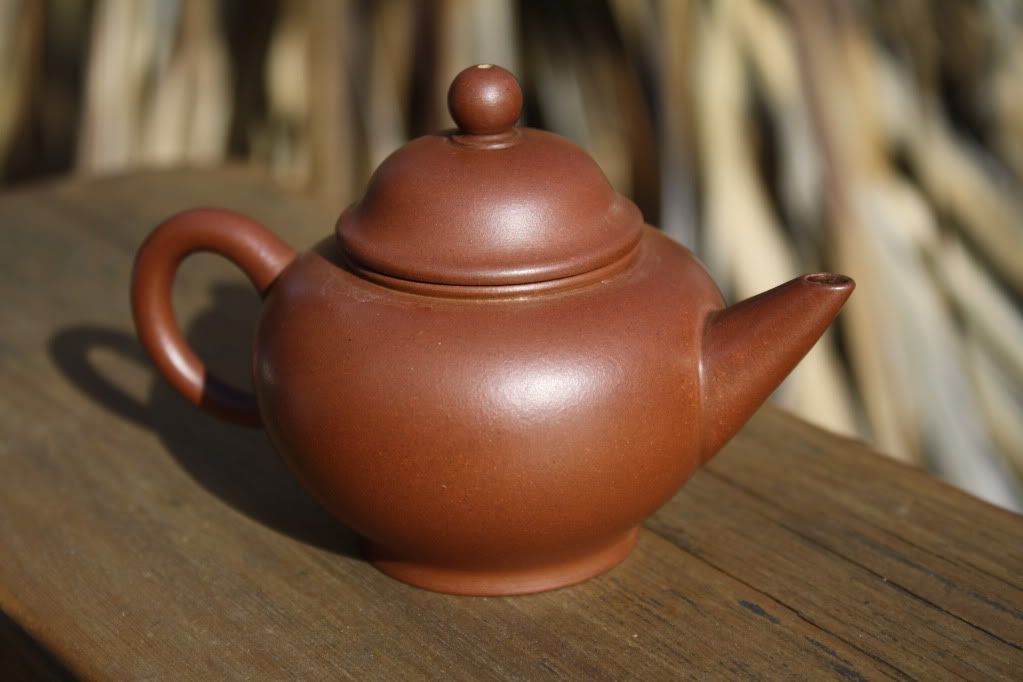
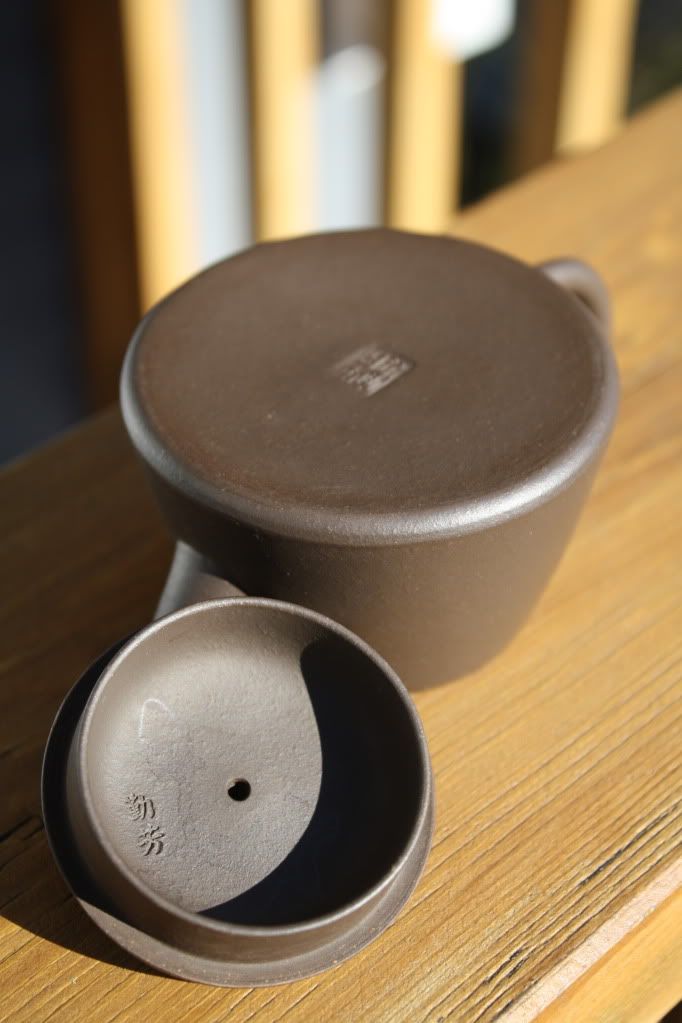
This afternoon I've been enjoying some 11 year old Song Zhong dancong oolong from Jing Tea Shop in this tiny ROC pin zi ni pot originally from Hou De. The pot is probably one of my nicest pieces of teaware; the clay has a sort of viscous visual texture, and the pot has an old sort of energy to it.  The clay's pretty high fired for being zi ni and the details are pretty well-done considering how small they are.  The only problem is that, although it was listed as having a 65ml capacity, its actual volume is only 55ml.  While I don't usually quibble over 10-20ml differences with pots, the difference here comes at that critical threshold that impacts the pot's practicality.  Especially with this pot's flat shape, 55ml is simply to small to use with most tea types; in my experience, even concerted efforts to make use of pots this small almost always results in tea that's less optimal than in slightly larger pots.  I love gong fu tea in small vessels, but if you go too small, you continue shrinking past the point of utility--the tea leaves stay the same size!  Even 65ml was a little on the edge of my ideal capacity; if I'd known the pot was this small I probably wouldn't have purchased it in the first place, but once I experienced it in person it was tough to want to part with it on aesthetic grounds.  So, because the leaves are small and I use a much smaller ratio than with other tea types, I can only use this pot effectively with dancong, which brings up some other issues.

While I do enjoy dancong, I don't keep a lot of it around because I go through it really slowly (I only use about 3-4 grams for 70ml of water, compared to about 6 for pu-erh and 7-9 for most yan cha) and because it's tough to find a tea I really want to drink more than two or three times in a season.  Like most other oolongs, dancongs are getting really green--the flavors, aromas and brewing durability are all pretty incredible, from what I've experienced, but I usually find myself longing for something with a bit more depth.  A good Mi Lan dancong is usually a bit more oxidized, but I've most enjoyed the dancong I've had that undergo at least moderate roasting (surprise surprise).  The floral aromas usually become much fruiter, the mouthfeel changes and, though the brewing durability usually reduces a bit, the tea's just much more up my alley.  And yet, it seems much easier to find green dancong.  This aged tea has mellowed just a bit in its storage, but really I think it's the roasting that makes it most enjoyable to me.  I wish I had more of it and more teas like it so I could use this pot a bit more--Jing Tea Shop's current Song Zhong is obviously much less roasted (though it receives comparatively higher roasting than some of their other qing xiang oolongs).  Anybody know any good roasted dancong teas?  I haven't tried (but am open to) Tea Habitat and am not especially crazy for the dancong I've had from Hou De, but haven't tried much else.

February 18, 2011

More Pot Pics


The last yixing pictures went down pretty well, so here's my other most-used pot.  I use this 1980's tall shui ping for pu-erh.  Since I primarily drink aged sheng pu-erh, that's mostly what's going into this pot, but on the occasion that I drink some younger or adolescent teas, I use this pot too.  It really isn't that important to militantly reserve pots for specific teas or tea types, as the effects of past brews are pretty negligible on how the pot typically brews a tea, especially if you only brew a certain type of tea in it once or twice.  It's really not going to make much of a difference. 


Rather, I'm more focused on how the clay of a particular pot affects the brew, and this pin zi ni is just tender enough to round out the body wile at the same time supporting the tea's aroma.  Since this pot is a bit "newer" and since I don't dip into my stash too often these days (it's easier on my wallet!) the patina is coming a little bit slower, but the inside seems to be darkening more quickly than with some other pots (it's only slightly visible above.


This pot's chop is the same as this one (which is upside down in the picture), and it refers to the fact that the pot was made at Yixing Factory #1 as a graduation model.  Shui ping isn't the most adventurous style of pot, but there's still something powerful about the simple aesthetic.  I really like that this one is a bit taller--the lid isn't quite as wide and has more of a vertical energy.  I think the compressed shape also contributes to its pour, which isn't the fastest but hardly leaks at all.  I've gone through a lot of pots trying to find one that feels right for a particular type of tea, and I hope this unassuming pot will be brewing my pu-erh for many many years.

February 16, 2011

This is your pot--on tea.

Lately I've been enjoying watching my teapots accumulate patina--it's the perfect hobby for a lazy nogoodnick like myself.  Here's some photojournalism with the help of a long-overdue new camera.  Yippee for close-ups!


This is my newer hei ni pot.  I've been using it for aged oolongs.  The shape is accommodating for just about any tea and the pour is great.  In my experience, hei ni, despite being classified as a tender clay, tends to brew pretty bitter greener oolongs, so it's a better match for something that's mellowed with a diminishing roast, or an oxidized low-roast oolong with little remaining bitterness.  I've been enjoying a light pot of aged oolong in the afternoons as I haven't been drinking a whole lot of tea during that part of the day.


One of my favorite features of this shi piao is the bottom--it's ever so slightly concave, with slightly rounded edges.  It feels great in-hand.


I've been using this pin zi ni pot for yancha for just over a year now, and it's certainly showing its use.  My unstated goal with this pot has been to get it as filthy as possible--I don't pour much tea over the top of my pots, but it definitely shows where the tea drips.  The tea stains are obvious, but what's pretty interesting is how the overall color begins to darken over time.  The only polishing I occasionally do is to gently rub off the water mineral deposits that build up around the opening and spout.


One of the enduring mysteries of yixing has been the accumulation of patina on the lid skirt--for some reason it builds up fastest there, to the point that it's completely covered, then the thick patina will start to come off in patches as you can see above.  It's already happened to several of my pots.  Is it friction?  The thick patina getting looser when the hot tea contacts it?  Who knows why?  Surely not I.


The inside of the pot seems to build patina at a much slower rate--the inside of the lid here shows graded evidence of patina, and the more-difficult-to-photograph interior is somewhere around that color.  It's hard to believe the photos I took when the pot arrived are even the same pot--it looks like plastic!  Hopefully I'll be able to hold off breaking this pot for a while so I can see just how dark it'll get.  It still makes great tea.


Here's another one I've been using heavily for quite a while.  It's about in that phase where the skirt is covered in patina.  We'll see if it starts to come off like the others.  This pot also makes awesome tea--roasted Taiwan oolong, especially Dong Ding.  I can tell that the more porous duan ni clay soaks up the patina more than hard clays, and the seasoning has resulted in more balanced brews.  The mouth feel is still velvety.


The bottom of this pot is flat, so there's some interesting build-up there too.  The huge lid doesn't fit too tightly, so there's some nice drip trails between the lid and spout and down the spout.  It seems like the more porous clay types tend to actually soak up the tea more than have it pile on top.  I feel like if I tried to polish this pot, the darkened areas would stay dark, but on a zhu ni pot the patina would probably just come off.  At the time of this writing, Jing Tea Shop still has one of these pots in stock...somebody's going to be happy.

Even when tea life isn't too exciting, there's still fun to be had watching the daily brews leave their marks.  You may have noticed I'm no longer posting under a pen name.  Don't get me wrong, I still love Gong, but I've decided to consolidate my blogging endeavors for convenience--my music blog is in the blogroll now if you're interested in checking it out.  I also work and blog for Seattle's Miro Tea, so it should probably be said that this blog is about my personal tea explorations and isn't affiliated with the store.  Plus, the idea of a blog pseudonym is a little ridiculous and paranoid anyway--there's not too much reason to worry about privacy violations (please request copies of my birth certificate and/or social security card in post comments) unless of course you're planning a group gathering in downtown Tehran.  Happy tea drinking...I'll hopefully be back soon with a rundown on two new traditional yan cha from Jing Tea Shop.

Elliot

August 12, 2010

Up for Air (Dong-Ding & More Teaware for Sale)

Wow, another two-month hiatus! The time has sure passed quickly. Music is again responsible for my retreat from the tea blogosphere; finishing recording, mixing, mastering and designing the album has taken nearly all of my spare time (and a large number of my sleep hours). It's been a good kind of busy, though. Very fulfilling and engaging on a level that few other things can match. I've still been drinking tea, of course, though I've been buying less of it in order to fund the upcoming CD release. I've also been keeping up on my favorite tea blogs, though after a few years of doing this it seems like summer is generally a slower period for tea blogging and tea vendor releases. A bit surprising, I guess, considering the summer is when almost all of the fresh tea is finally available! Maybe everyone is just too busy drinking to write.

Today I'll consider my most recent yixing purchase as well as one of the most recent tea purchases I made (all the way back in June!). The pot comes from Jing Tea Shop (who still has at least one identical pot still in stock). Good quality duan ni clay; ~100ml capacity. The lid opening is the largest out of any pot I've ever owned, which makes getting leaves in and out extremely easy. I don't recall seeing a lot of duan ni teapots around on blogs; though a fair number of vendors sell them, they aren't often lauded by consumers. Well I'm here today to do just that. I think people are often a bit worried by this clay's porosity. Yes, it is quite porous--usually not high-fired and with plenty of potential to draw something out of your tea. It's probably that characteristic that worries some people: "Well it'll just suck the flavor out of my tea." Yeah, maybe if you're using it with green gaoshan oolong or young sheng pu-erh. After a fair bit of experimentation, I've found this pot makes certain teas taste better than any other pot I own--teas where something NEEDS to be drawn out. For example, heavily charcoal roasted teas like Wuyi Yan Cha, Taiwanese oolongs like Muzha Tieguanyin, Dong-Ding, etc., or aged sheng and cooked pu-erh. In addition to merely rounding out the actual flavor of the tea, I find more porous clays can smooth and thicken the mouthfeel to an astounding degree.

However, pots like this do take some seasoning before performing at their best (probably another reason why people are a bit tentative about trying this type of clay). When I first started using it, this pot only brewed one tea ideally--a very heavily charcoal-baked Dong Ding that I'm saving for a couple of years. After some patient seasoning, though, this pot produces mouth-wateringly smooth, full-feeling sessions from most Dong-Dings and now expertly handles teas with higher floral notes like Muzha Tieguanyin and traditional roasted Anxi Tieguanyin. I won't lie--I had to sacrifice a couple of teas to the seasoning of this pot--in particular a decently machine-roasted competition Dong-Ding from Hou De, which was just a bit too green to overcome the porosity. All in the name of an awesome pot, though.

Needless to say, I've been drinking a whole lot of Dong-Ding lately. The aforementioned heavily charcoal-baked Dong-Ding and a less heavily charcoal roasted Dong-Ding both came from Floating Leaves Tea. Although I've been tea friends with Shiuwen for a couple of years, I haven't bought much tea from her because I consume very little of gaoshan oolongs like Baozhong, Lishan, etc., and those are her speciality. This spring, though, she bought some really tasty aged teas and small quantities of a few Dong-Dings. I apologize for being part of the reason that these teas never made it to her website! I'm hoping Shiuwen continues to expand into the arena of charcoal-roasted teas, because with her seasoned palate she picked some really good ones that exhibit both skilled roasting and solid tea bases. The lesser-roasted of the two gave me constant companionship through my final recording sessions--a week of 10-12 hour working days--so it's got a special place in my heart, not to mention some really solid seasoning for its pot. Those two teas and the success I had with my new duan ni pot inspired me to crack open a charcoal roasted Dong-Ding purchased from Hou De about a year and a half ago; unsurprisingly that one's now nearly gone!

Well, I owe a couple posts--one on a handful of tea samples that Stephane at Teamasters was kind enough to send me quite a while back, and another on the brand new Essence of Tea sheng pu-erh cakes that recently completed their long voyage from China to England and thence to Seattle. Until then, those interested can have a look at my TEAWARE FOR SALE page; it's time to thin out the tea shelf again and there are 3 very nice yixing pots available (one rather old) and 2 Xu De Jia cups (originally from Hou De). Best wishes, and I hope everyone is enjoying their respective summers. Weather in Seattle has been, to be blunt, piss-poor. Luckily, though, cool weather is better for tea drinking!

February 24, 2010

Hot or not?

Today was a great day--two tea packages arrived, one from Hou De and one from Jing Tea Shop. Packages from China are always nerve wracking, and I usually spend several days expectantly looking out the window for the postman before the package is actually delivered. This one didn't arrive as quickly as some, but today my wait was mercifully cut short.

There are a few items worth mentioning between the two boxes, but I'll start with this little miscreant. After my last delightful Jing Tea Shop purchase, not only did I shrug off the vestiges of my "too cool for more teapots" attitude, it seems my mental disorder was only exacerbated. I asked SEb at Jing if he could find me a decent duanni pot, and this is what he came up with, along with a nice little story:
Yesterday, I went to visit a good friend who is a Yixing national craft master and I found that he has made a xiao pin of one of his latest series of 3 teapots for which he was recognized, they even printed stamps with them. It is a 100ml, made of good duan ni, pours really well and has very nice details. It will be good for black tea, especially cooked pu erh.
I almost always go for traditional, unadorned pot shapes, and it's been quite a while since I've had a bamboo pot in the collection. At first look, I really wasn't sure what to make of it--the leaf details, spout and handle are familiar from other bamboo pots, but the body shape is totally out there--the large body section resembles a separate pot that is tilted backward (in the picture below you can kind of see that the weird outside shape is totally evidenced on the inner surface as well).


Now that the pot is in-hand, I'm still not sure what I think about the aesthetics. The clay is nice and tender, though, and rather high-fired as well, so I don't doubt it'll make some tasty tea. I'm also excited to see how the bright yellow clay seasons--in just a month's time my two newer pots have shown dramatic changes from seasoning, and this one's probably even more porous. I've shown pictures of the pot to a number of tea-drinking and non-tea-drinking friends and opinions have been split on the imperfect shape--probably the best reaction was from my girlfriend. I don't remember the exact phrasing, but the word "poop" was a key descriptor.

So, I'd like to propose a simple survey on the aesthetics of this pot--hot or not?

January 26, 2010

Good--New Acquisitions.

It had been about 4 months (not very long, but it seems like a long time) since I'd purchased any teaware. Sometimes impulses take over, though, and something has to be done.


These two pots came from Jing Tea Shop, one of my standby vendors. I love this seller because they've always had solid quality, but since I've started purchasing from them they've continued to get better--their Dancongs were really great this spring, they always have a good yen cha selection (now with lots more info for each tea), they often offer aged pu-erh, and they just recently added a "Xiao Pin" section to their yixing shop. Alright! Having spent some time dabbling in the expensive and baffling world of vintage and antique yixing, I actually now feel more confident purchasing recently-made yixing ware. The primary selling point for antique yixing is often clay quality. The most obvious example is zhuni, which is probably best bought as antique, in my opinion. With other clays, though, I've found that I can't detect as much difference between recent and old examples to make it worth the 3x or more price increase. What I've found is that volume capacity, lid fit, pour, and general performance are more important to me than age or a modicum of clay quality improvement. Even if a pot is Qing dynasty and gorgeous zhuni, if it's 200 ml and has a leaky lid, it'll drive me crazy and end up sitting on the shelf.

The first pot is an 80ml 1980's pin zi ni shui ping. What strikes me about this pot is the crispness of the edges. In hand it feels so sharp and precise. It operates flawlessly; quick pour, dripping only when vertical, and the lid hole doesn't get filled with water too easily. I also really like that the lid is completely flat; it'll be interesting to watch how it seasons differently from the other pots I have. Both pots have interesting chops--this one has a bunch of extra characters in addition to the central stamp, a style I haven't really seen before.

The second is a 2006 Ben Shan lu ni shui ping. It's actually the first really traditional-style shui ping I've owned, which is fun. The clay on this one is really cool--a deep forest green which, because of the "yao bian" intentional over-firing, has taken on a bit of a red tint on the outside and a much redder color on the inside. The color looks different depending on the type of light that's hitting the pot (you can see the difference even in the three pictures here); it looks really cool in sunlight, but unfortunately the clouds rolled in by the time these pictures were taken. This one is not quite as ideal operationally; though the lid fits very well, there's a bit of a drip when pouring. I don't mind screens in a yixing spout (especially for fragmented teas like pu-erh and yen cha), but I'm not entirely sold on the efficacy of a bubble/golf ball style; I think it might slow down the pour a bit and could contribute to leakage. If the biggest problem with a pot is a little stream running down the outside of the spout, I don't really mind too much, since I often just stick the pot into the fair cup to empty it. Another interesting chop--this one is dated. Since this one is dated 2006, it's pretty believable (who would forge a date on a 4 year-old pot?), but I wonder just how reliable this type of thing will be in 20 years...it seems like the forge-ability of the original artist's chop is still the issue.


Aside from the re-awakening of my pure collector's spirit, I've been looking for a back-up yen cha pot (aside: The pot that titles this blog, despite now being beautifully seasoned, has had a couple of injuries and now has a hairline crack in the lid. I'm heartbroken at the prospect that someday soon it might be unusable, but it's made me a lot of good tea) and a smaller pot for sheng pu-erh, so I've had fun over the past 2 days testing out teas in these pots. I don't usually detect a huge difference between clays, but these two pots have surprised me. Both produce a rounder mouthfeel than more dense clays, and the lu ni seems to soften and round the most. The high notes in the flavor are better-preserved by the pin zi ni, and the walls retain heat a bit better. I think either could make good yen cha or pu-erh, but the pin zi ni pot's faster pour will be more conducive to making yen cha. I'm going to spend some time seasoning the lu ni pot to see how its effects on flavor turn out, but I think it might have a future as a good aged sheng pot. Either way, I'm excited to have some well-working tender clay yixing pots back in my collection; up until now my most porous pots have been hong ni, which is only porous compared to zhu ni!

May 17, 2009

Si Ting Zhuni Yixing (Hey tea guy!)

As I was going for a run earlier today and crossed the main street of the neighborhood's "downtown" area, some guy inside a shop yelled out the open door "Hey tea guy!" I flashed him the "rock on" sign and kept running. It doesn't get much better than that.

The results are in, and the people want yixing (thankfully, since the longjing hasn't arrived yet). Since Tuo Cha Tea mentioned the titular pot for this blog, I'll start there. Fill your teapot up with tea/come and take a ride with me!

This pot has got to be my #1 favorite, if I had to pick one, aesthetically as well as functionally. I acquired it from Hou De last August, started using it for Yen Cha and other roasted oolongs ever since. Here are some quick stats--Age: "60's or early." Clay: Zhuni. Capacity: 85 ml. I'm not planning to talk about prices with these pot profiles; I don't think it's really necessary, as you can compare prices of other pots on the websites where the pot came from; plus it's about finding the perfect pot, not how much the perfect pot costs. I have no idea how to guess or verify the age of a pot, but since this APPEARS to be genuine zhuni, it would have to be several decades old. I've also got no way of verifying the clay type either, but compared to modern zhuni pots I've had, the surface texture is definitely naturally glossier, more complex-looking, and there's evidence of shrinkage both on the surface of the clay and around the hand working lines (visible in many of these pics). In the end, whether or not it's some sort of "true" zhuni isn't really that important to me; the piece satisfies me on so many levels that it's a joy to be able to use it every day. Comparing the below pic to the others you can see how different the clay looks in different types of light; this seems accentuated with zhuni pots, but it's definitely true of most yixing I've seen (thankfully the day I took all of these pics provided good light and my camera actually held up its end of the bargain).

Why do I like this pot so much? Let me count the ways... The size is perfect for solo drinking; the entire pot fits into the celadon tea cup I usually use, and the small size means I can pack it with Yen Cha without using too much leaf or getting too buzzed. Despite the single hole, the pot rarely ever seems to clog, which is more than I can say for many pots I've had. The clay is extremely dense, retaining heat for a ridiculous amount of time and giving a very high-pitch ring if tapped. The pour is perfectly dripless, really fast and creates a graceful arc. The handle is tiny but fits my hand very well. The above picture shows that the shui pin line appears pretty solid and also that the inside of the pot is becoming well-seasoned from all the dark oolong it's been fed. Most of my non-zhuni pots are more recent additions, so I'm interested to see how the seasoning process works on more porous pots, but so far that visibly stained part of the lid has seasoned the fastest. I'm not sure why, but that's the part that always seems to build up the fastest. You can't really see in any of the other pictures, but the inside of the lid is starting to get a nice patina, and on the pictures where the inside of the pot is visible you can see the inside of the pot is beginning to darken as well. If you click on the large picture you can see that the inner burnishing has an interesting "combed" looking texture.


Another reason that this pot functions extremely well is because the hole in the knob is pretty large. With many pots that I have with smaller holes, the hole tends to become blocked with steam water. This, of course, prevents the hole from allowing the tea water to displace the air up inside the lid's dome when the lid is placed on the full pot, so if you put the lid on when the hole is blocked, it shoves a lid-sized amount of tea out of the pot. This pot almost never does that, so I don't have to spend much time blowing the water out of the hole. You can also see in the above pic that some patina is developing on the crook of the spout. Anywhere that tea water can come to rest on a pot seems to build patina faster.

A couple more things before I put this one to bed. Interestingly, there isn't a bottom seal on this pot, just the one right below the handle. A Taiwanese friend expressed surprise that I use this pot for Yen Cha (instead of...High Mt. Oolong, I guess). I'm a little suspicious of any claims that zhuni only works with certain teas. Before I bought a few more pots, I used to use this one for a lot of different teas (Dancong, aged and un-aged sheng pu-erh), and it always performed well, giving a clear representation of the tea without any foreign flavors. The shape might be a little confining for pellet oolong, and now that it's more seasoned the roasting element might not be great for green oolong, but I think the clay type has potential to be used with any tea type. I also compared the same tea in this pot and a few other pots (including a Duan ni pot, which is supposed to be ideal for roasted tea) and I actually liked it better out of this pot. You can laugh at me all you want; I'll be enjoying some delicious Yen Cha. Don't let anyone convince you of something without confirming it with your own senses! This pot has been so good to me; at the time I hadn't owned many high-quality or collectible yixing pots, so I didn't know how great of a find it was, aesthetically and functionally. Since, I've had plenty of pots educate me on the possible deficiencies in yixing potmaking to the point where I'd probably pay much more for this pot if I had to buy it again; it's that worth it. I recently did a very bad thing (after taking these pics; no leaves on the trees in these) and dropped the lid. The bottom rim suffered an extremely minute chip. It bothered me more than I wanted it to and I cursed myself for damaging such a vibrant piece of irreplaceable functional art for over a week, but I eventually got over it. I hope to be able to use this pot in good condition for years to come, so I'd better be more careful.
--
Post-script! I've heard a lot of bloggers badmouth "internet pots" and claim that "you just can't get a good pot on the internet," and I just have to vehemently disagree. I've bought pots in person and online, and the online pots have been much much better. Thing is, you have to have a trustworthy vendor. Of course, the 4000Friends $7 eBay pots are going to be terrible, but you could guess that easily. There are a few really great vendors online who sell authentic and high-quality pots and do a great job representing them. Yes, Guang and Irene at Hou De do sometimes have to charge a bit to make margin on their pots, but they really know their stuff and if they say a pot has a perfect pour with no drips, they're not lying. Of all the vendors I've bought pots from, Hou De offers the most consistently brilliant pots, sacrificing very little in the way of ideal characteristics. That's one reason I wanted to write about some of my yixing; to identify which vendors are great sources and why. I also want to share my experiences and especially my mistakes so hopefully others can avoid them or have a better idea of what to look for when buying a pot online or in person. If anyone out there has pictures or blog posts about their yixing, please do share! I always love seeing other pots, especially well-loved ones.