Showing posts with label Jing Tea Shop. Show all posts

June 20, 2011

2011 Long jing

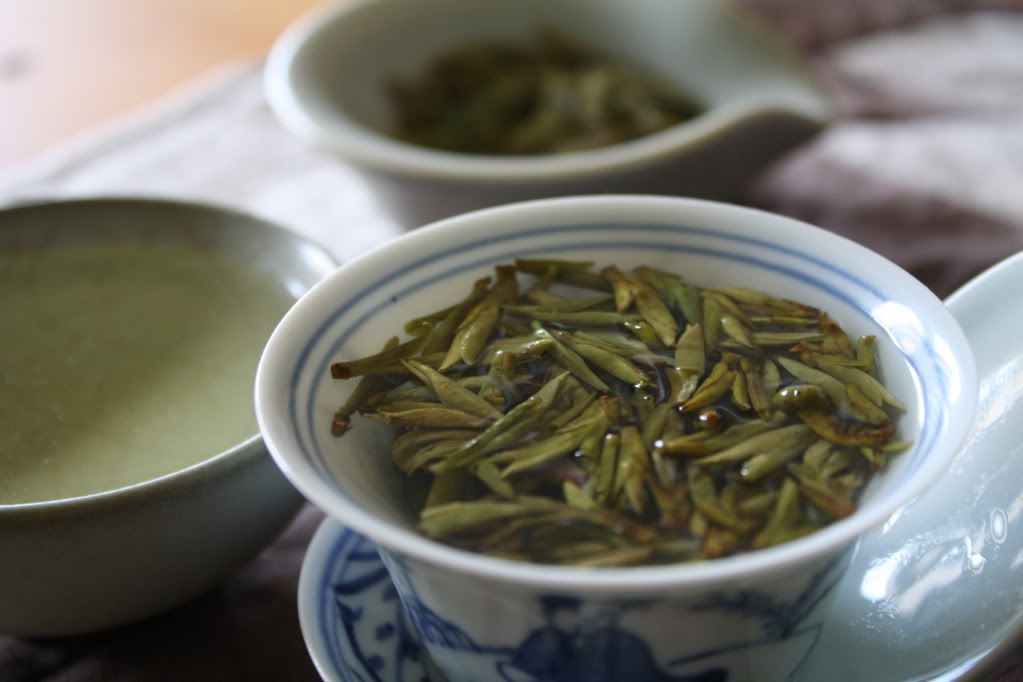
It's once again green tea time.  As I've mentioned in past spring posts, I really look forward to drinking Chinese greens while they're fresh from the recent harvest.  This year I've been drinking more than ever--mostly from two of my usual suspects in Jing Tea Shop and Teaspring.  Today I decided to sit down and try the two long jing I purchased this spring for the sake of comparison.


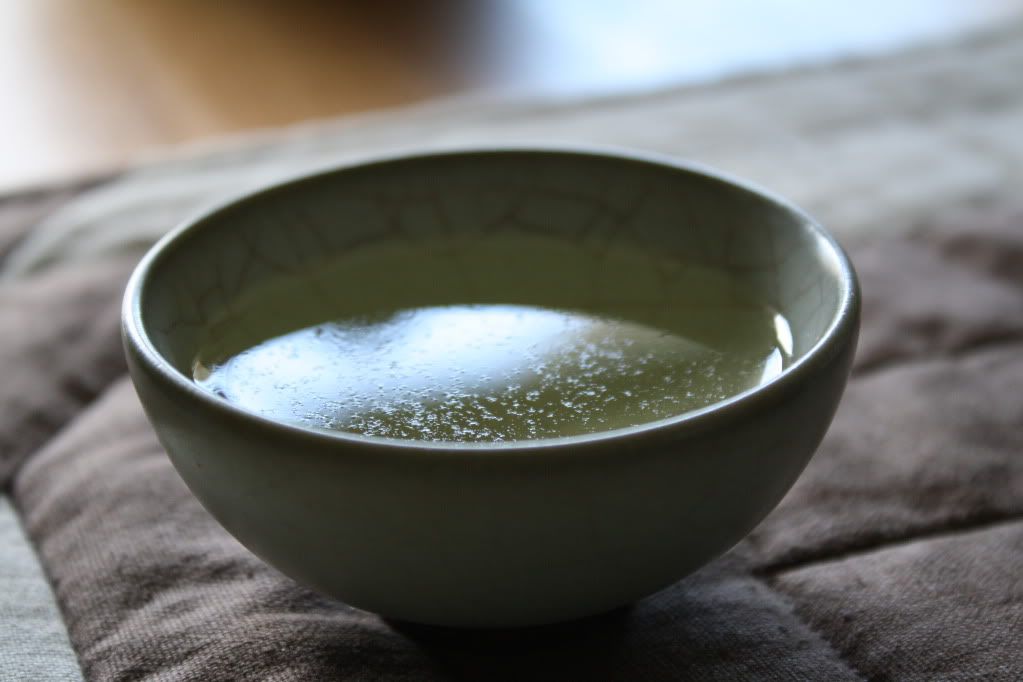
I've been brewing my teas pretty casually this spring--bring the water to a boil, then fill my celadon fair cup with water.  When it's cooled down to the proper temperature (sometimes I'll pour it back and forth between a second fair cup and the cup I'll be using) I'll start steeping the tea, topping the cool water fair cup from the kettle's hotter water with each infusion. After I decant the tea into the second fair cup, I'll pour about half of it into the drinking cup, mixing the next infusion with the remainder, and so on.  While this method hardly allows for scientific scrutiny of each infusion, that's not what I'm really looking for and the overall session tends to produce a more consistent standard of quality from each cup.

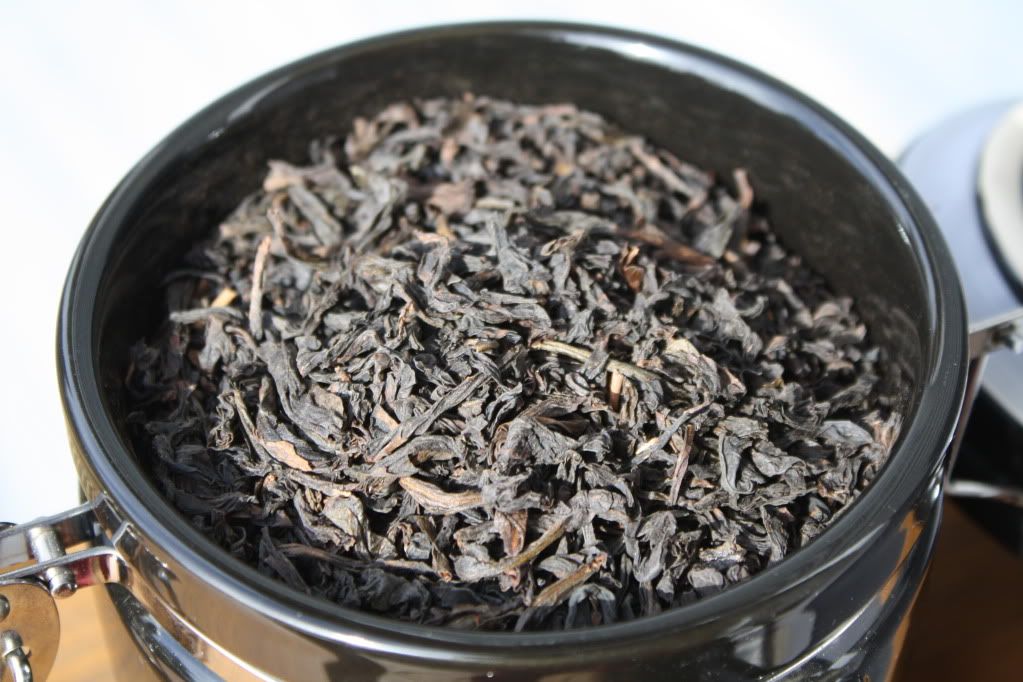
That's some hairy tea.
So, that's how I brewed my dragonwell today.  First, Teaspring's Emperor Long Jing and second, Jing's Shi Feng Long Jing.  I get the impression from reading the notes that Jing's tea is a bit more on the hand-selected side, but who knows for sure?  Both sites have offered teas that I've enjoyed for the last four years or so, and I usually have very few objections.  To my surprise (I thought Jing's would be better), they're both pretty good long jing--but different.  The Emperor example is more up-front, with a more robust body, a bolder flavor and more of the chestnut notes people usually associate with long jing.  The Shi Feng example, though, is subtler, with a lot of sweetness but less of a bold body.  It reveals its character in the aftertaste rather than immediately, and develops more of a vegetal flavor throughout the infusions, even appearing greener to the eye after the session ends.  As usual, I'm glad I tried both teas together, because I likely wouldn't have picked up on the differences trying them days apart. 

Somewhat on the subject, I just added an Eilong studio gaiwan to the Teaware For Sale page.

June 17, 2011

A Teapot


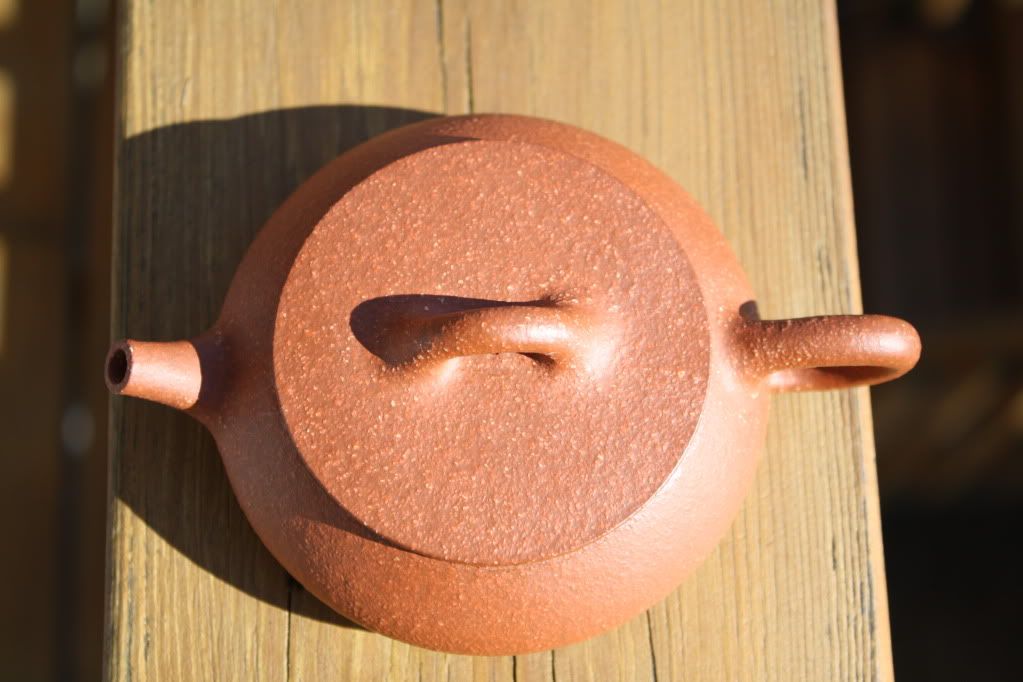
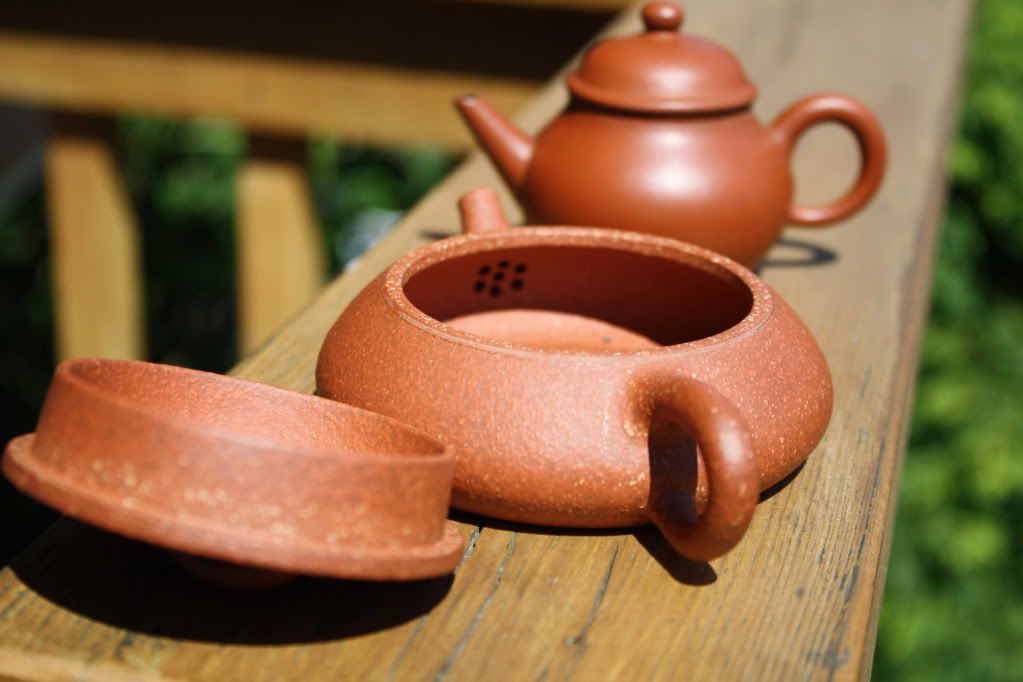
Nothing too exciting happening today--just sharing a relatively recent and strange Yixing purchase and some thoughts on Yixing in general.  I've coveted a nice, classic shi piao teapot for a while, since the ones I've owned so far haven't really worked out (too big or just not good enough).  It's a classic shape that I find attractive in a lot of ways--the unassuming-yet-jollily-angled spout, the graceful lid handle, the characteristic shape of the pot handle, and the generally solid performance pouring and accommodating most tea types.  So, I purchased this one from Jing Tea Shop, which, incidentally just listed a handful of nice-looking xiao pin teapots for those in "need."   At 120ml it's a little larger than my ideal size (usually around 100ml) but I enjoy having a slightly larger pot around, and you don't always have to fill the thing completely full.  When the pot arrived, though, I was quite surprised--thought the listing described the pot as "flat," the pictures couldn't quite capture just how smooshed this pot actually is--it's like somebody squashed it before it was fired, and the main body is barely over an inch tall (for comparison you can see my tiny 70ml hong ni dancong pot, which looks immensely tall in comparison).


Consequently, the pot is quite wide (probably about four inches) for its volume.  Also interesting is the clay, which is described as "Cu Sha Hong Pin Zi Ni."  "Cu Sha" is straightforward--there are some pretty knobbly sand grains blended into the clay, but "Hong Pin Zi Ni" is something I haven't heard of before--pin zi ni is a general term to describe a blend of different zi ni clays, so there can be a pretty broad spectrum of different appearances between different clays labeled as pin zi ni.  But the "hong" is a strange addition--is this pin zi ni blended with hong ni?  Or is there a type of clay that somehow qualifies as zi ni that's actually red?  The answers to these questions sit firmly in the "hell if I know" category.  The origin of the clay's blending aside, it's pretty cool-looking.  The picture below probably best displays the simultaneous visibility of both red, more traditionally brown pin zi ni, and the sand in spite of the bright conditions caused by the "hot" Seattle sun (hey, I'm not complaining). 


Despite how unusual it is, this pot actually works quite well--obviously the lid opening is huge, so it's quite easy to get the leaves in and out, and the pour is much smoother than I expected--a lot of times weirdly-shaped pots don't perform very well.  Another thing I've noticed using this slightly larger pot is that the traditional "rules" about tea-type-to-pot-shape pairing become less and less important the larger the pot is--if this shi piao were 80ml, it would be quite ill-sized for brewing pellet rolled oolongs, as the tea wouldn't have the proper space and shaped area in which to expand.  A bit larger, though, and there's plenty of room, so the pot can be used with really just about any kind of tea, though I'm sure some work better than others with the unusual clay.  I've only been using the pot occasionally to brew mostly steeped-out teas or a weak pot with just a few leaves, so I haven't been too picky about what goes in there.  Works for me.

March 3, 2011

Dipping into the Stash

I recently made the somewhat difficult decision to open a large canister of oolong I'd been planning to age.  It's a 2008 Traditional Shui Xian from Jing Tea Shop, and I've been storing it for just about a year myself with hopes of opening it much later and enjoying a delightful aged yan cha (right?).  The present question is, why open it instead of continuing to age it?


From what I've experienced, there seem to be three different types of aged yan cha.  First is the well-roasted type that tastes overly of charcoal when it's first processed.  Impatient me, I usually enjoy and drink these types of tea regularly without aging, but have also had numerous examples of three to five year-old teas that taste really nice.  The charcoal aspect seems to lose its sharpness and ease off into a more rounded, mellow darkness.  I wouldn't really consider these teas aged--more "set-aside" to balance the flavors and become ideal for drinking.  For the most part, they still taste like young yan cha.  The second kind of aged yan cha is the well-aged, old variety.  Here we're talking much older, definitely more than 10 years and upwards of 15 or 20.  These teas don't taste much like young yan cha at all.  They're more like other aged (usually Taiwanese) oolongs--plummy, mellow, sweet, and without as strong a tea taste.  If they were heavily roasted when they were young, they're usually full of dark flavor notes, and if they were less roasted then they tend to have more shifting, sometimes sour high notes.  I'd venture to call this the ideal for aged yan cha.  The third type of aged tea is more of an odd duck--I've tasted teas of this stripe that were supposedly from the 90's, and I've tasted teas that taste eerily similar that range from five to only a couple of years old.  They generally don't taste like young yan cha (not much of a charcoal note at all) but they don't taste like the other aged yan cha.  The flavor is vaguely plummy and a bit aged, but not usually as complex as the second type.  There's nothing wrong with this type of aged tea, but from the ones I've had, they all taste pretty similar to each other and none have been as satisfying as an "ideal," a "set-aside" or just a good new yan cha.  My experiences are pretty limited, so this type may be what's considered standard aged yan cha, so maybe I'm getting it wrong, but I'm really hoping that not very many of the teas I've set aside turn out this way.


This brings me back to the tea I've just reopened.  When I chose to age some of it a year ago I did so based on the fact that I really enjoyed drinking it--though it's a very reasonably-priced tea ($7/oz, I think) it has the roast level, body and flavor/aroma I look for in an everyday yan cha.  I've since had a bit of trouble finding teas like this to drink regularly, let alone age.  In the meantime I've been trying a number of "aged" teas of the third variety that make me worry for my aging experiments.  If this tea were to turn out like those, I'd end up with a passable but not excellent aged tea that I would have enjoyed much more in its youth.  It seems like it's probably better to leave the aging risk to the other teas I've set aside that aren't quite as high on my "ideal to drink now" list.  If they don't turn out fantastic, at least I won't have lost the chance to drink them when I would have enjoyed them most.  After a year's home storage, this tea is still tasting really nice.  It's still a bit drier than the 2010 Traditional Shui Xian, but it still has the nice creamy mouthfeel that its younger counterpart has in even more abundance.  Its roast is pretty high, if not the highest I've had, which puts it in the first category, which is probably the one I prefer most on a daily basis--it's a tea that's been set aside for a few years and it's reached an ideal balance but still tastes like new yan cha.

This last point touches on an interesting lesson I have to continually remind myself about.  That is, you always have to ask yourself why you're aging a tea.  Is it an experiment--can my aged tea taste as good as the one I bought that was aged by somebody else?  Is it because the tea is shitty and you're hoping the aging process will turn it into something worth drinking?  I've got a couple of those.  Is it because you prefer the aged version of the tea and aren't interested in the young one?  That's basically my stance on young sheng pu-erh, which I appreciate but rarely drink for enjoyment.  When I buy young sheng, it's purely for the sake of aging--the main risk is that it won't age.  If you buy something with the intention of aging it but actually love it just how it is now, you could find yourself wishing you drank it when it tasted how you liked it.  It's easy to get caught up in the "aged is better" attitude but you'll always benefit if you're realistic about your tastes.  I drink aged oolongs casually and occasionally, so why should I commit a huge amount of tea to aging when I'd enjoy it more now, even if it turns into a good aged tea?  No sense incurring "ager's remorse"!

February 24, 2010

Hot or not?

Today was a great day--two tea packages arrived, one from Hou De and one from Jing Tea Shop. Packages from China are always nerve wracking, and I usually spend several days expectantly looking out the window for the postman before the package is actually delivered. This one didn't arrive as quickly as some, but today my wait was mercifully cut short.

There are a few items worth mentioning between the two boxes, but I'll start with this little miscreant. After my last delightful Jing Tea Shop purchase, not only did I shrug off the vestiges of my "too cool for more teapots" attitude, it seems my mental disorder was only exacerbated. I asked SEb at Jing if he could find me a decent duanni pot, and this is what he came up with, along with a nice little story:
Yesterday, I went to visit a good friend who is a Yixing national craft master and I found that he has made a xiao pin of one of his latest series of 3 teapots for which he was recognized, they even printed stamps with them. It is a 100ml, made of good duan ni, pours really well and has very nice details. It will be good for black tea, especially cooked pu erh.
I almost always go for traditional, unadorned pot shapes, and it's been quite a while since I've had a bamboo pot in the collection. At first look, I really wasn't sure what to make of it--the leaf details, spout and handle are familiar from other bamboo pots, but the body shape is totally out there--the large body section resembles a separate pot that is tilted backward (in the picture below you can kind of see that the weird outside shape is totally evidenced on the inner surface as well).


Now that the pot is in-hand, I'm still not sure what I think about the aesthetics. The clay is nice and tender, though, and rather high-fired as well, so I don't doubt it'll make some tasty tea. I'm also excited to see how the bright yellow clay seasons--in just a month's time my two newer pots have shown dramatic changes from seasoning, and this one's probably even more porous. I've shown pictures of the pot to a number of tea-drinking and non-tea-drinking friends and opinions have been split on the imperfect shape--probably the best reaction was from my girlfriend. I don't remember the exact phrasing, but the word "poop" was a key descriptor.

So, I'd like to propose a simple survey on the aesthetics of this pot--hot or not?

January 26, 2010

Good--New Acquisitions.

It had been about 4 months (not very long, but it seems like a long time) since I'd purchased any teaware. Sometimes impulses take over, though, and something has to be done.


These two pots came from Jing Tea Shop, one of my standby vendors. I love this seller because they've always had solid quality, but since I've started purchasing from them they've continued to get better--their Dancongs were really great this spring, they always have a good yen cha selection (now with lots more info for each tea), they often offer aged pu-erh, and they just recently added a "Xiao Pin" section to their yixing shop. Alright! Having spent some time dabbling in the expensive and baffling world of vintage and antique yixing, I actually now feel more confident purchasing recently-made yixing ware. The primary selling point for antique yixing is often clay quality. The most obvious example is zhuni, which is probably best bought as antique, in my opinion. With other clays, though, I've found that I can't detect as much difference between recent and old examples to make it worth the 3x or more price increase. What I've found is that volume capacity, lid fit, pour, and general performance are more important to me than age or a modicum of clay quality improvement. Even if a pot is Qing dynasty and gorgeous zhuni, if it's 200 ml and has a leaky lid, it'll drive me crazy and end up sitting on the shelf.

The first pot is an 80ml 1980's pin zi ni shui ping. What strikes me about this pot is the crispness of the edges. In hand it feels so sharp and precise. It operates flawlessly; quick pour, dripping only when vertical, and the lid hole doesn't get filled with water too easily. I also really like that the lid is completely flat; it'll be interesting to watch how it seasons differently from the other pots I have. Both pots have interesting chops--this one has a bunch of extra characters in addition to the central stamp, a style I haven't really seen before.

The second is a 2006 Ben Shan lu ni shui ping. It's actually the first really traditional-style shui ping I've owned, which is fun. The clay on this one is really cool--a deep forest green which, because of the "yao bian" intentional over-firing, has taken on a bit of a red tint on the outside and a much redder color on the inside. The color looks different depending on the type of light that's hitting the pot (you can see the difference even in the three pictures here); it looks really cool in sunlight, but unfortunately the clouds rolled in by the time these pictures were taken. This one is not quite as ideal operationally; though the lid fits very well, there's a bit of a drip when pouring. I don't mind screens in a yixing spout (especially for fragmented teas like pu-erh and yen cha), but I'm not entirely sold on the efficacy of a bubble/golf ball style; I think it might slow down the pour a bit and could contribute to leakage. If the biggest problem with a pot is a little stream running down the outside of the spout, I don't really mind too much, since I often just stick the pot into the fair cup to empty it. Another interesting chop--this one is dated. Since this one is dated 2006, it's pretty believable (who would forge a date on a 4 year-old pot?), but I wonder just how reliable this type of thing will be in 20 years...it seems like the forge-ability of the original artist's chop is still the issue.


Aside from the re-awakening of my pure collector's spirit, I've been looking for a back-up yen cha pot (aside: The pot that titles this blog, despite now being beautifully seasoned, has had a couple of injuries and now has a hairline crack in the lid. I'm heartbroken at the prospect that someday soon it might be unusable, but it's made me a lot of good tea) and a smaller pot for sheng pu-erh, so I've had fun over the past 2 days testing out teas in these pots. I don't usually detect a huge difference between clays, but these two pots have surprised me. Both produce a rounder mouthfeel than more dense clays, and the lu ni seems to soften and round the most. The high notes in the flavor are better-preserved by the pin zi ni, and the walls retain heat a bit better. I think either could make good yen cha or pu-erh, but the pin zi ni pot's faster pour will be more conducive to making yen cha. I'm going to spend some time seasoning the lu ni pot to see how its effects on flavor turn out, but I think it might have a future as a good aged sheng pot. Either way, I'm excited to have some well-working tender clay yixing pots back in my collection; up until now my most porous pots have been hong ni, which is only porous compared to zhu ni!

March 23, 2009

Bai Ji Guan Trifecta

Ok, so that's not what trifecta means, but it sounds cool, so sometimes I use it to describe three of something. Bai Ji Guan means white cockscomb, which is that thing on a rooster's head, and it's one of the Si Da Ming Cong, or the four famous Yen Cha cultivars (the others being Da Hong Pao, Shui Jin Gui, and Tie Luo Han). There are a few things that are almost always said when describing Bai Ji Guan, so I'll get them out of the way in attempts to avoid dwelling on the same old same old. The first is that the tea gets its name from a legend about a rooster that died protecting its chicks, or some such story, or that the tea is so named because its leaves actually resemble a rooster's crest. Tea naming legends don't really interest me very much, though the physical appearance of Bai Ji Guan's leaves is quite striking in comparison with other teas--they are generally a much paler yellow, are rather small and almost seem a little more translucent. The second thing that people always seem to mention when describing Bai Ji Guan is that it's the rarest of the Si Da Ming Cong. Seven Cups offers more information than most regarding why this is (the cultivar's touchiness to growing and climate conditions and the sensitive and limited harvest window), but most vendors are content to leave it at "rare." From personal experience, Bai Ji Guan is quite rare insofar as its availability to the West is concerned; few online sellers even offer a Bai Ji Guan, and if they do it's usually quite expensive. It's also pretty difficult to find more than the cursory information I've already mentioned and few bloggers have posted experiences about the tea.

Why the Bai Ji Guan obsession? Hou De used to sell a Bai Ji Guan from 2004; I encountered it near the beginning of my blossoming passion for yen cha (a little less than a year ago) and was blown away by its flavor--different from every other yen cha I've tried, with a vibrant fruity/floral acidity that floated lightly over the tea's obviously skillful roasting job. Well, Hou De eventually sold out of the tea and, though I've got a bit tucked away, I've been on a search for more of the same ever since. The catch is, though, I have yet to encounter another Bai Ji Guan that is even processed in the same manner, let alone as high-quality. In some ways, my Bai Ji Guan quest is the ultimate microcosm of my intentions with this blog--my quest to find more Bai Ji Guan has also been a quest to understand what exactly the characteristics of authentic Bai Ji Guan are, and how and where I can get more of the one that caught my taste buds. Unfortunately my attempts to prolong the magic have thus far been thwarted--of four other Bai Ji Guans I've tried, none have even come close to the style of Hou De's. I have, however, learned quite a bit about what seem to be the tea's hallmark characteristics. Here I'd like to humbly share what little I've learned from my attempts, in case you've heard of Bai Ji Guan but haven't wanted to shell out the big bucks to try it. Tasting notes for three examples follow.

The well-informed and generous staff at Seven Cups were kind enough to include samples of both their 2007 Bai Ji Guan and their 2008 Bai Ji Guan with a recent order. Before I launch into my notes and impressions, I'll say that the difference between Hou De's Bai Ji Guan and every single other one I've tried (including one from Teaspring) has been roasting--all the others have been comparatively extremely lightly roasted, which imparts a totally different flavor and aroma. As I inspected the greenish brown leaves of Seven Cups' 2007 tea, I immediately knew I wasn't going to find my elusive tea, but I eagerly anticipated a chance to try another piece of the puzzle. Please forgive the quality of the pictures--clouds make for dull natural light, so the colors aren't quite as vibrant as they appear to the naked eye, but flashes are so harsh. The leaves are complete but small (especially for yen cha). A common denominator I've noticed with all examples I've tried is that the dry leaves are two-toned--one dark and one lighter and yellowish. As you can see in both pictures, they're a delight to behold and I could personally spend hours inspecting the delightful intricacies of each leaf.

After a few experiences, I've learned to brew Bai Ji Guan differently from other yen cha. Usually I'll stuff the pot over half full with leaves and flash infuse the teas for the first four infusions, increasing by 10-15 seconds on each later infusion. This tea's lighter roasting changes the rules, though, and that much leaf just makes the tea too strong in an unpleasant way (unlike the strength of a heavier-roasted yen cha, which I find pleasant, if quite powerful). So, as I try to understand this tea's needs I've had better results with about a one third-full pot and a slightly longer first infusion (15 or so seconds), dropping down to 5ish for the next few, then climbing back up as taste determines. I wish I could go in-depth with this 2007 tea, but unfortunately the results were pretty disappointing. Brewed with my trusty yen cha setup (zhuni pot and celadon pitcher and cup), the aroma and flavor were familiar and immediately recognizable as kindred to the other light-roast Bai Ji Guans I've tried. It's got a totally unique oolong flavor, and there's really little to know noticeable relationship to your average yen cha. You might as well be drinking alien tea, but please don't ask me what alien tea tastes like (I am not at liberty to either confirm or disconfirm the existence of alien tea). There's a savory vegetal aroma that immediately emanates from the leaves, offering a light honeysuckle sweetness that is immediately accessible. In some ways this tea is reminiscent of green tea in aroma and flavor, but with an oolong's body, complexity and longevity. Sadly, my experience with Seven Cups' 2007 example didn't go so hot--the first infusion confirmed my expectations for the tea and gave me enough information to say "Yep, it's Bai Ji Guan," but the flavor seemed shy. Though this isn't uncommon in first infusions, the tea never really increased in potency as the session wore on--insipidity came on pretty quickly (around the 4th or 5th go) and a several minute infusion even failed to produce much flavor. I'm wholeheartedly open to the prospect that my preparation of the tea could be the cause for these results, but I've prepared similar examples (including Seven Cups 2008 tea) in the same fashion with completely different (and successful results). Depending on storage conditions, 2 years could be just a little too long for this lightly-roasted tea, and I respectfully submit that this tea might be past its "sell by" date, especially considering the fact that $38/25g raises customer expectations considerably. Despite the tea's diminished power, it's still fun to take a look at the cashed leaves--I've noticed that the leaves often display widely varying color and oxidation, ranging from dark green leaves to pale, almost yellow ones, and the oxidation is always beautiful and easy to spot. If only the tea were a bit fresher.

Happily, Seven Cups' 2008 Bai Ji Guan fared much better compared to the previous year's harvest. According to the web site, the tea received a slightly higher roasting to prevent any grassy taste from the weather conditions on the day of harvest. Though the leaves are pretty similar in appearance, you can tell the difference in comparison of both photos (as well as in the liquor, which is a few shades darker). Even more so, the aroma and flavor betray the roasting. The same sweet, flowery and honeyed notes are there, but are complemented by the bewitching darker, woodier roasting element that only caramelized the floral aspects of the lighter-roasted version. In the flavor, the roast takes on a really pleasant chocolate-like sweetness. Though I drink a lot of yen cha, I don't tend to liken their darker aspects to chocolate, but here the description seems pretty direct. Like other fresh Bai Ji Guans I've tried, this one goes on and on, taking shorter infusions at the beginning with gentle results and yeilding up thinning but minutely evolving flavor with longer later infusions. Despite the longer infusions, the tea's astringency is neither unpleasant nor powerful, which is a plus. Unfortunately I didn't get a chance to photograph the spent leaves; though the first tea's flavor was weak, its caffeine apparently wasn't! By the time I finished both teas, I was levelled by caffeine and fled desperately in search of food and plain water. Needless to say, I was much more impressed with this example than the first, and I liked it enough to flirt with the idea of purchasing some, though I'll have to think it through a bit more, considering the price is similar to the 2007 tea.


Finally, we have Jing Tea Shop's 2008 Bai Ji Guan. Though this tea comes from 2008, its roasting seems to be lighter than Seven Cups'. Since I shelled out $78 for 100g of this tea, it is the Bai Ji Guan with which I've had the most experience. Unfortunately this included burning up a few pots' worth of tea with bad brewing parameters and mistakes. Expensive education! Thankfully, though, this experience allowed me a little more confidence in preparing my one-shot samples from Seven Cups. Though this tea didn't recapture my elusive Hou De lark, it is quite a pleasant tea to drink. Thick, syrupy liquor with plenty of flowery honey and an almost tingly mouthfeel. As pictured, the liquor resembles that of the first tea, though a bit darker because of the cup's depth (as Captain Beyond lurks above, awaiting play at the Stepping Stone's vinyl night). Like some others I've tried, it does seem to march on indefinitely above 10 infusions, which is certainly a plus. Usually I get worn out before the tea does! Astringency is again present, but in appropriate quantity and quality. The flavor of this tea is unique and pleasant, but as far as gong fu brewing goes, it's not especially dynamic, that is to say it doesn't make a whole lot of evolution flavor and aroma-wise throughout a session. So, at its premium price, I'm not sure I'll be rushing out to buy 100 more grams anytime soon, if I even go through my tea very quickly. Thankfully, Jing Tea Shop also offers 25g samples at a reasonably increased fraction of the 100g cost (reasonably priced samples of every tea is one of my favorite things about Jing Tea Shop, which is one of my go-to vendors for Chinese oolongs, greens, and sometimes pu-erh).


Overall, tasting these teas has been a very educational if not wholly satisfying pursuit. Though Bai Ji Guan is unique in flavor, I'm not sure the price is justified for my tastes. Today I actually dug out the remainder of the sample I purchased from Teaspring--if it compares favorably to Jing's (which in my memory it does) I might say that you should try Teaspring's instead of Jing's if you're curious, since it is considerably less expensive. Stay tuned for that update, if you're interested. I now feel like I've got a decent handle on what light-roast Bai Ji Guan is supposed to taste like. If (as according to Seven Cups) the tea is actually traditionally lightly-roasted, I suppose I can appreciate the tea's traditional processing, but I still yearn for the experience I've had with Hou De's 2004 Bai Ji Guan (I'll review a bit of my final stash in the future). The hunt continues.

March 20, 2009

1999 Menghai 7352 from Jing Tea Shop

I...might've glid before...

More sheng pu-erh! This is a sample of Menghai's 7352 recipe purchased from Jing Tea Shop. It dates from 1999 and, according to its brief description, it's 'dry stored,' which could mean any number of things. Perhaps more informatively, it's been dry stored in Guangdong province, China, which we can assume means something different from 'it's been dry stored in Phoenix, Arizona,' probably in a good way. There's so much debate online about the proper storage of aging pu-erh, especially from a humidity perspective, that this tea is even more interesting to try from an academic perspective. Most of the aged pu-erh I've had the opportunity to try has been supplied via Taiwan, which comes with certain biases regarding ideal flavor, storage, which cakes achieve popularity amongst the booming afficionado market etc., so it's especially informative to receive a more diverse example. Considering the cupboard I've got full of pu-erh cakes, I'm already invested in this debate, so it's with bated breath that I try and learn just how dry and cool a storage environment can be without destroying a cake's chances of aging. I consider this cake a key piece of information in the spectrum of different storage styles and conditions.

The leaves of the sample are already well-separated, which doesn't really bother me (as long as they're not powdered), though I probably prefer larger chunks. They're still looking pretty young, but not excessively so--they're darkening and looking just a bit frosted. Rinsed in the pot, the aroma has that dusty sweetness that I have come to lovingly associate with the few delicious dry-stored aged pu-erhs I've had the privilege to enjoy. The leaf aroma also betrays a healthy remnant of smokiness. I'm happy that it appears to be diminishing, leading me to wonder how many more years until it's gone completely.

This tea is in a transitory phase between the young, raw characteristics I'm very familiar with, and the aged maturity that is less readily available in quantity. Somebody in one of the Art of Tea magazines said that teas of this maturity aren't fun to drink, but I have to disagree--if the aging characteristics were only very slight, I might concur, but here it's really straddling the line, which I find quite pleasant. I have to admit that I have found myself a bit bummed that some of my favorite characteristics found in young sheng have been nowhere to be found in some of the aged pu-erhs I've tried, and it's nice to taste that light, airy quality that makes the tea very active in the mouth. The first couple of infusions are healthily bitter, but the bitterness recedes and partially sweetens in the aftertaste. The liquor's color surely shows the aging progress, and that mist on top of the cup is always fun to take in. The smoke is quite subdued in the flavor, and what's more prominent is a mushroomy, sweet wood flavor that sweetens more with air and as the tea cools. Astringency is still potent, though pleasant--could be my proclivity for yen cha, but I don't mind a bit of saliva when I'm drinking tea (as long as it's my own). The aroma in my tea pitcher is definitely less engaging than the last tea I tasted, leaning toward the smoky and sharp side, kind of an emphasis on that mustardy smell I mentioned in the last notes. Interestingly enough, the final, long and mellowing infusions are where this tea's aged qualities become most pronounced and a thicker musty sweetness becomes the dominant flavor. I don't know anything about this blend (it seems not to be one of the very top blends from Menghai) but this tea drinking experience is on a really promising track.

If the aging of this tea continues the way it has, I could see it being really dynamite in another 10 years--no more smoke, no astringency, and no bitterness, and it would be just like that delicious 80's 7542 ching bing that Hou De used to have samples of. From a personal perspective, since this tea has very definite aging progress and very definite room to complete its maturity, I should be able to monitor its progress (or lack thereof) fairly accurately as I try to determine firsthand whether or not pu-erh can actually be aged in the Pacific Northwest's climate, or if I should stop buying young pu-erh. Let the hand-wringing continue.

March 4, 2009

Jing Tea Shop's Xing Ren Dancong Oolong - Winter 2007

I'd have liked to kick this blog off with something exceedingly special, but instead it's just what I spent my morning drinking--what could be better? This is the 2007 winter harvest of Jing Tea Shop's Xing Ren Dancong oolong.


Most of the Dancong that can be found online and in the flesh here in the US are generally of underwhelming quality (not to mention boring in their lack of diversity)--usually they seem to be of the medium-roast, "Milan" variety, though they'll often be called simply "Dancong." With crap quality being the norm, it's no wonder Dancong as an oolong genre is not well-known in the West, let alone in other places. I have to admit I first fell in love with Jing's Dancongs because of the pictures. Just look at those huge, multicolored leaves--it's like a much more interesting-looking Baozhong! With only a tiny bit of research, it turns out that Dancong seems to be one of the most diverse oolong categories out there--the number of cultivars is about as huge as with Wuyi Yen Cha, and the flavor variety is even larger! This particular Dancong (whoops, didn't take any leaf pics this time) is on the lighter oxidation side, with only a light roasting. The unfurled leaves are generally pretty yellowish-green, with maybe a few brown oxidation blotches.

Robbie Basho's "The Falconer's Arm" seems to be the perfect music this morning. Cascading, ecstatic 12-string guitar really adds to a thoughtful mood. I brewed this one in a teapot I purchased at Jing--I'll put up a teapot profile later, but it's called "Yu Ru Hu" and it's made of modern Zhuni. It was my first pot purchase at Jing, and I'd say it was a pretty worthy investment; at the very least it's brewing delicious Dancong whenever I want it! The lovely tea mat was made for my by my aunt. Celadon cup and pitcher came from Hou De; they're solid and retain heat very well. Though I haven't gone as celadon-crazy as Bret from Tea Goober, I've certainly bought a few. It's rare to find hand-made pottery of this quality for such a nice price, and the size and functionality of the pieces I've purchased have been really ideal for my everyday needs, which is the most important part for me.

Anyway, if you haven't tried one of these lighter-oxidation and roasting Dancongs, it's definitely worth at least a sample; they're unique as far as I can tell. The first couple infusions give off a room-filling fruity/floral aroma. Compared to Jing's Ba Xian, which was my other favorite, this one has a slightly savory edge to supplement the tropical amalgam of fruit and flowers--maybe that's why this Dancong's name means "almond seed." I'm not sure if it reminds me of almonds in the least, but the added "foody" dimension makes this one the winner of Jing's greener Dancongs, as far as I'm concerned. One other interesting facet of these teas is the leaf aroma. Sniffing the pot at the beginning is a dizzying, intoxicating experience that combines notes of the tea's flavors with an unrelated, juicy smell that persists even after the tea leaves have cashed out on flavor. As the infusions wear on, the leaf aroma gradually loses its complexity until it's just this fruity base.


The other thing I'll note is that this tea actually has a nice, thick syrupy body (check out its light golden color in the pic above), though the astringency seems to come on after the third infusion or so. This confuses me a bit--I usually associate astringency with heavy firing--like with a Dong-Ding or Yen Cha, but this tea is only lightly roasted...I guess there are some other factors at work, though, since green tea racks up some pretty righteous astringency after several infusions too. Maybe it's because the tea is almost a year old? Despite the astringency, this tea will soldier on through 10+ infusions really easily--I always feel good about teas that can last forever. Combined with the price (under $30 for 100g) it's a pretty good value as well, compared with some of the jaw-droppingly expensive premium Dancongs available out there. This winter's harvest is still pretty fresh--this tea is listed as AA grade, while the Ba Xian and Yu Lan are AAA. I'm not sure what exactly separates the grades--leaf uniformity? Leaf size? Regardless, this one's my favorite from a flavor perspective. As usual with Jing, the tea made it all the way from China without experiencing much damage--lots of whole, big leaves. Makes me wonder why a lot of the Yen Cha I get from the US has to be so beat up and fragmented. I bought a bit too much of these Dancongs (100g each of this and the Ba Xian) for my rate of consumption, but I've promised myself not to buy this season's until I've finished off the older stuff, which is still holding up quite nicely. It's tough!

Zero