Showing posts with label Essence of Tea. Show all posts

July 16, 2011

Black Butte Tea

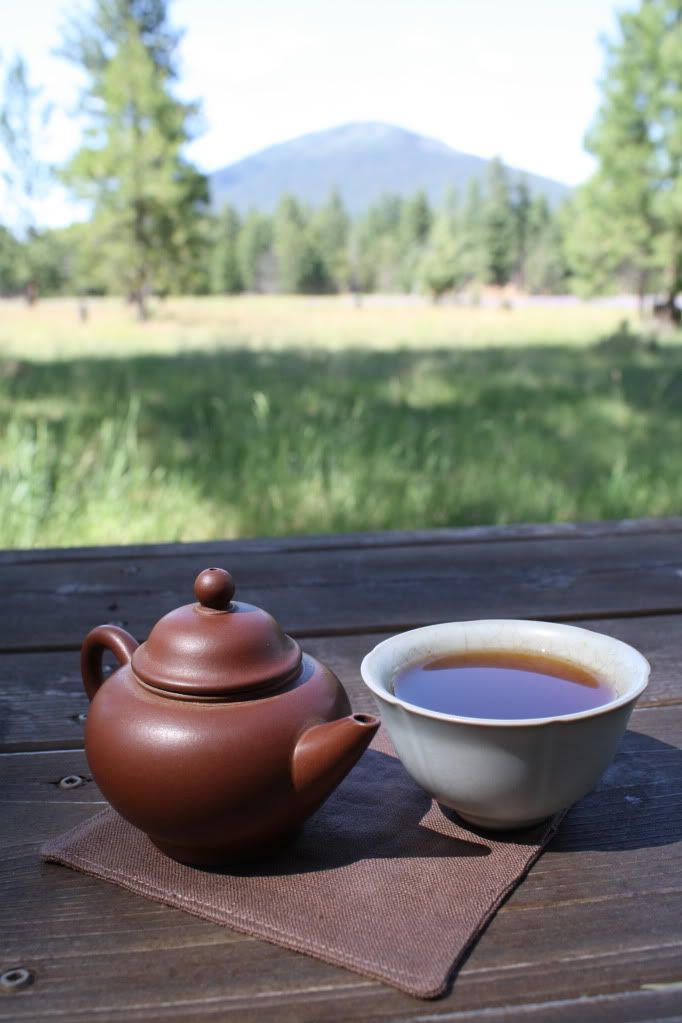
Not the blackest butte I've ever seen.  Please forgive the titular pun.
Or, Tea on Vacation Part II.  This past week I've again been fortunate enough to vacation away from home.  This time I've returned to a time-honored summer haunt for my family--Black Butte Ranch in central Oregon.  It's been a great week full of relaxation, physical recreation (including a scenic climb up the pictured butte), productivity (music for a couple of songs and a handful of textual contributions), and--of course--tea drinking!  As I mentioned but didn't document at the time of our last visit, Black Butte is home to a delightful and accessible spring, from which I've been drawing my tea water for the week.

Perhaps unsurprisingly, it's also been a week of numerous minor tea learning experiences at the mild, reflective pace of a good vacation.  Compared with my last trip, I brought almost everything but the kitchen sink (in terms of tea équipage, that is).  The tetsubin, two yixing pots, a gaiwan, and a dozen or so different types of tea.  Lesson #1: Even on a "fully-equipped" vacation, it's probably still smartest to focus on one tea type, because you probably won't make full use of all the different teas you brought, and you get the benefit of close comparison between different teas of the same genre.  Although I made green tea and a delicious Dong-Ding, I mostly drank aged pu-erh.  If I had left the other teas at home, I could have left the gaiwan and one of the pots, not to mention the tea storage space--ah, the joys of over-packing to avoid silly fear of "not enough variety." 

It was a pretty decadent week, since I usually only drink an aged pu-erh every couple of weeks, but all of the repetition was illuminating.  Firstly, a muted session with an '80's shou/sheng brick reminded me that different weather conditions (it's quite dry here) can affect my sensory faculties and, perhaps, the performance of the tea leaves themselves.  Secondly, the failure of an extremely tight chunk of '80's tuo to fully unfurl reminded me that breaking up large chunks (as gently and possible, even if it's difficult) greatly improves the quality of the session--you don't have to separate individual leaves, but getting the chunk into quarters is significant.  Thirdly, a sublime one-off session with my 1993 7542 reminded me how not all sessions with a single tea are created equal and that there's no shame in the notion that a certain chunk of the cake might be contain a just right combination of leaves, while others may not (Lessons #2-4, respectively).

The final learning experience relates to perspective.  Two years ago--drinking many of the same teas I drank this week, incidentally--I was deliriously eager to try my tetsubin and teas out with mountain spring water.  With a couple more years' experience under my belt, my attitudes to spring water and tea preparation in general have mellowed quite a bit.  Whether it's my rustic palate or my lackadaisical approach, the difference between filtered/Lynnwood spring/Black Butte spring water is not especially apparent to me.  Maybe with some close attention I could tell a difference, but that might spoil the relaxation!  Probably the most enjoyable part of making tea with this spring water is retrieving it--it's really enjoyable to collect the fresh, cold water straight out of the earth and reflect on and feel connected to the elements that come together for a good tea session (definitely nowhere close to the extent that those who are attentive to Chinese elemental tradition do, though).  The water tastes amazing right out of the ground--perfectly cold for a hot day after the bike ride to the spring.  It's also interesting to note that, two years after acquiring the tetsubin and using it with spring water, it still hasn't developed much of a mineral scale/patina at all.  I was really nervous when I first noticed the patina was receding, but now I'm little less anxious; the thing still makes good tea water, and preferable to my other kettles--even to my simpleton's palate.  If anything, I'm wondering whether or not it's really necessary to drive up to Lynnwood to regularly collect water, since the patina hasn't returned.  We'll see after I use up the 10 gallons of water I'm bringing back with me.
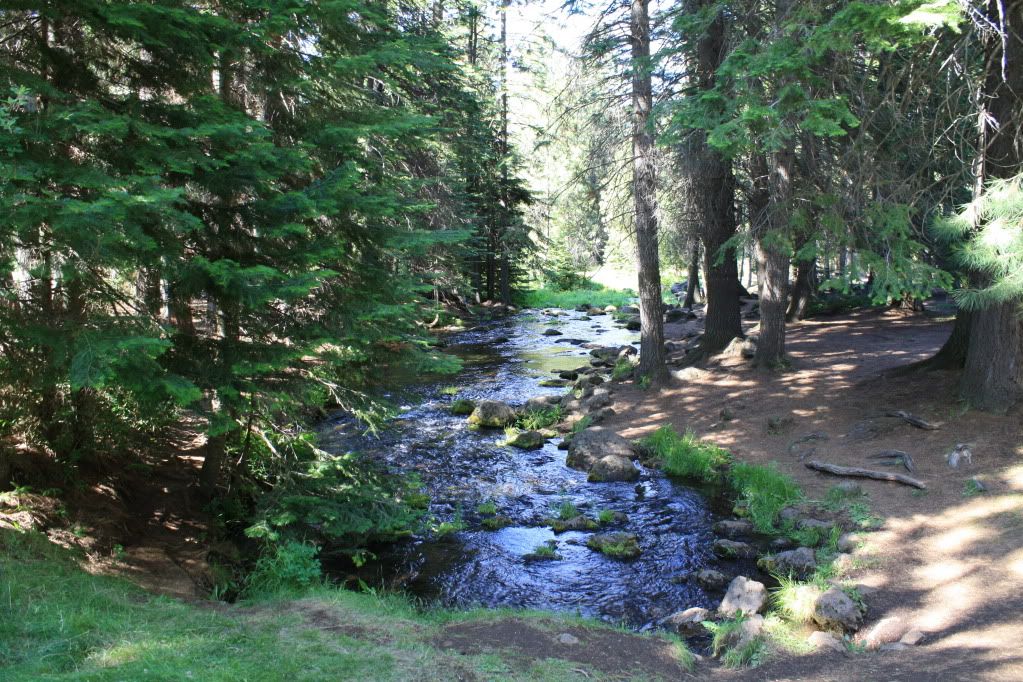
Where'd that come from?

The spring is a great spot--issuing straight out of the ground below where I stood to take this photo and running across the ranch.  There's also a stone bench--a great spot to sit and read, write or quietly enjoy the babbling stream, insects, rodents, birds and wind through the pines.
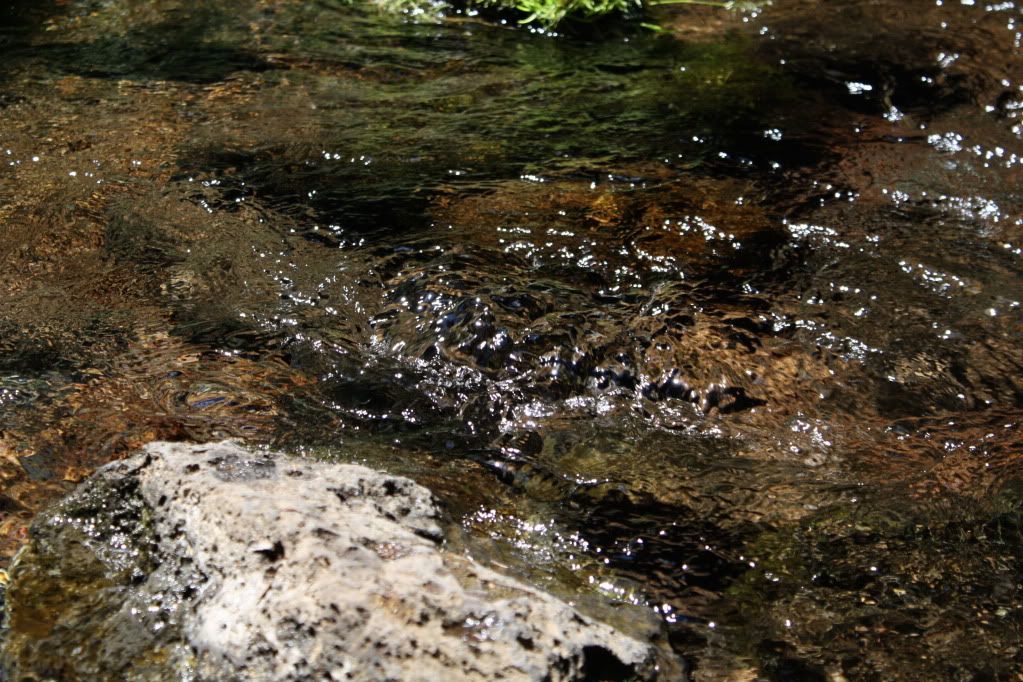
Water mushrooms.

Unlike the Lynnwood spring, which is technically an "artesian well" (meaning that it was originally human-drilled and since then produces water without pumping), this is an honest-to-goodness spring, bubbling straight out of the ground.  While not quite as convenient for jug-filling, it's an invigorating sight to behold.  Here's to drinking tea in the aid of relaxation and contemplation, and to continually learning about it without getting too scientific!

June 4, 2011

1990's Small Yellow Label CNNP 7532

It's been a while since I promised Matt a post about this tea--partly because Seattle's weather has been pathetically uncooperative for tea photo shoots.  Anyone who's followed the online pu-erh market for any length of time has surely noticed the most recent surge in prices of both aged and young pu-erh.  Unsurprisingly, a lot of us have felt a bit alarmed and have made attempts to nab up a few teas before their prices reach unpurchaseable levels--nothing like a good old market panic to drive the prices up even more.  Having avoided buying much aged pu-erh for a while, I decided to join in the frenzy and purchase some teas I'd been eying for a while.  Like most of the aged pu-erh I tend to post about, this tea comes from Essence of Tea, which means that the strength of the British Pound Sterling versus the US Dollar is an additional factor.  Thankfully it's been pretty stable around $1.60-$1.65 as of late--about average for the last few years, but thankfully nowhere near the $2ish levels it reached around '06.  I suppose the point is that, for once, I actually planned a bit before plunging into this purchase.

Let's find out: One, two, three...three.

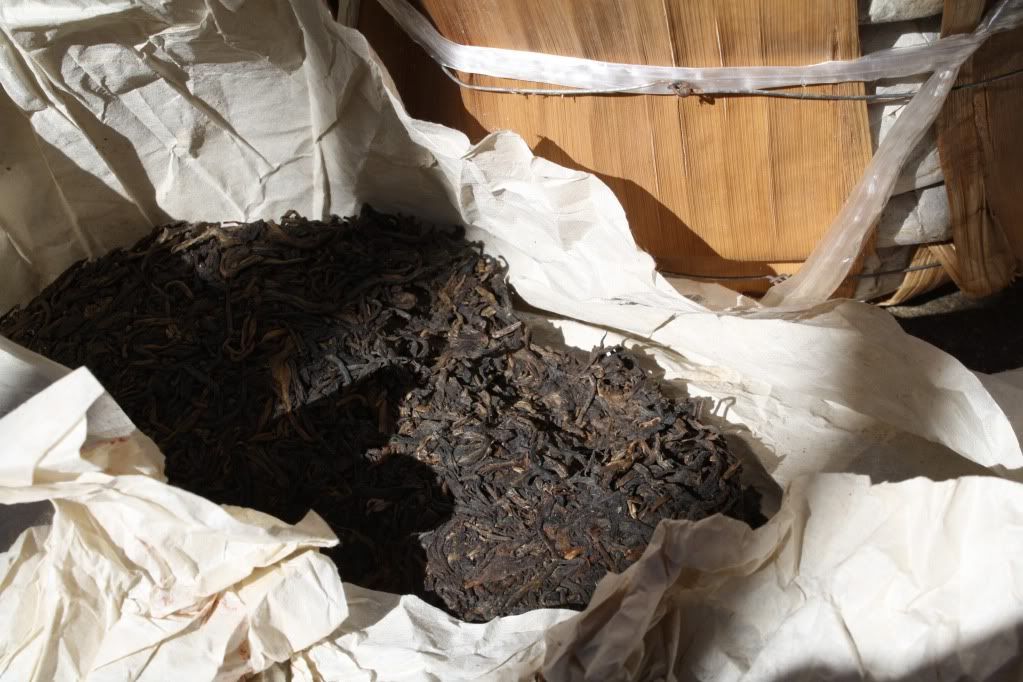
So, this is only the second full tong of pu-erh I've ever purchased.  What was the first, you ask?  Back in 2007 when I knew very little about pu-erh I bought a tong of this tea on sale from Royal Puer in celebration of the shop's first anniversary, thinking it'd be good to have a large amount of "some pu-erh," as if all pu-erh is pretty much the same.  Talk about falling down the rabbit hole.  For the foolish but fairly inexpensive $70 investment, it's a pu-erh of acceptable quality, though I have my doubts as to how well it'll age starting from complete immaturity in the Pacific Northwest.  My main regret is the fact that I ripped the bamboo wrapper completely off right after receiving the tea and the cakes have been loose ever since.  With my most recent tong purchase, my past mistake resulted in behavior of a polar opposite nature--perverse neurosis.  So obsessed with keeping the tong whole for who knows how long, I decided I needed to buy one more cake to work on in the meantime.  Perverse neurosis. 

Oh no, almost gone!  Better buy another cake so I don't have to break into the tong!
Now that I've so greedily hoarded a substantial stash of this tea, perhaps it'd be a good time to try it for the first time?  Joking!  Only joking--I tried numerous samples of this tea before making the purchase.  What do I look like, 2007 me?  This 90's cake is by no means an exceptional aged pu-erh.  Like very few aged pu-erhs, though, it actually inhabits a sweet spot of agedness, quality and price I like to call "value."  Since the tea's only labeled "90's," I assume it's toward the late end of the decade.  If considered as a twelve-year-old aged tea, it's remarkably mature (even for a tea from the mid- or early-90's, I'd say).  There's very little in the way of astringency remaining, the liquor is quite dark and it's only bitter if egregiously oversteeped or too many leaves are used.  I can only assume that it's gone through some fairly humid storage, though the cake surface is really quite clean and mold-free.  There is, however, an attractive staining of the wrapper and tickets that would indicate a bit of humidity, juiciness or both.

 Flavor-wise, it's no paragon of complexity--the notes are mostly what I'd expect from my past experiences with 90s CNNP--standard pu-erh plus a solid dose of sticky huang pian sweetness.  There's plenty of humidity and earth in the flavor to corroborate the other evidence, but this tea's storage is by no means as tough to handle as the stomach-churning (for me, anyway) Hong Kong storage of its similarly-priced EoT brethren, the Late 90's Grand Yellow Label.  There's no sparkling complexity that can be found in more special aged sheng, but it's a far cry from the one-dimensionality often exhibited by aged loose teas, for example, providing a handful of simultaneous flavor and mouthfeel experiences and a noticeable progression during a long brewing session.  This is a tea I thoroughly enjoy drinking now and will be happy to continue drinking whether or not its aging progresses, which gets at the primary motivation behind this purchase. 

I find myself less and less often looking for amazing, unparalleled examples of a certain type of tea, but more often for good, solid examples that are "the way I like it" and can be enjoyed repeatedly without the stress of budgeting a tiny quantity.  Not that I don't appreciate amazing tea, but I can't afford a ton of it and tea drinking is such a part of my lifestyle that I can't always pay the kind of attention that extremely expensive, good tea deserves.  This tea fits bill, and after buying so much of it I can virtually drink as much as I want without any fear of running out before finding out whether or not it's continued aging.  Also importantly, if I simply feel like casually drinking "some pu-erh" I can turn to this tea instead of a much more expensive one, thereby making my more modest stocks of those teas last much longer.  In the months since I special ordered my tong I see the full cakes have sold out.  I'm hoping David and Kathy restock this tea soon, as I feel it's probably the best value for its agedness on the Western-oriented web--what an affordable way to learn about aged pu-erh!  At roughly $90 for a cake, this tea is priced below innumerable cakes of 2005 or later vintage that provide no insight into the experience of drinking aged pu-erh, an experience I feel is usually unjustifiably difficult and expensive to achieve in the Western tea drinking world.

September 16, 2010

Relaxation

Ah, to kick back with a relaxing cup of tea. I've been way too busy lately with planning and executing my CD release. Now the event is over and it's a perfect opportunity to pause reflect over a few cups of tea. Today I'm drinking 1996 Menghai 8582.

This is an interesting tea in my collection; I own a few cakes but it's not really to the point where I really enjoy every session. Compared with some of its mid/late 90's contemporaries it's not the most mature tea--the mouthfeel is fairly rough and the longevity isn't particularly impressive. Occasionally, though, it'll show flashes of the light, silky sweetness that I've tasted in much older versions of the same recipe. It's certainly aging, but it needs to mellow out quite a bit. This is the kind of mid-aged pu-erh that I'll check in on every several months and by the end of the session I usually decide that I should wait longer before trying it again. Still, it's been months since I last drank it and I haven't really drank much aged pu-erh lately.

Whilst in Portland picking up my finished CDs I also managed to make a couple of purchases. The first is the nicest acoustic guitar I've yet owned--a Larrivée D-03R--and the second is the antique Japanese porcelain cup pictured right, which I found at Shogun's Gallery on NW 23rd. I've been disrespectfully sullying the cup with Chinese tea for the better part of the last week! I've been on the lookout for a decent blue and white old porcelain cup for a while and this one fits the bill--its pale blue swooping bird is pretty cool and I enjoy the irregularity of the foot, which means that the cup is permanently cocked at a slight angle. Shogun's Gallery was fun--they have quite a selection of tetsubin in the $200-$350 range. Although I was informed that most of their customers buy them as decorations, there were a few with visible mineral patinas that I would be excited to take a chance and brew some water in. I was quietly appalled to see an old tetsubin on the proprietors' desk repurposed as a pen-and-scissor holder. Gasp! Hopefully there was a good reason. I rarely get to go to nice teaware stores, so my "don't buy something" threshold is quite low. Luckily I got off pretty easy with the teacup. The new guitar means I won't exactly be splurging on any tongs of pu-erh or old pots any time soon, but a guitar that begs to be played is worth several times its weight in gold.

Seattle's summer came and went over the course of about 3 weeks. It's now drizzling interminably....it's warm enough to open the windows, though, so at least my pu-erh cakes are going to enjoy the weather.

May 23, 2010

Early 80's Da Ye

This tea (pictured R, below a thorny intruder!) can be had from Essence of Tea (formerly NadaCha) for a mere £750/350g bing. Even with the GBP taking a beating like it's taking right now, this tea's price is daunting. Luckily, it's also available by the gram, and for an achievable investment a pot's worth can be yours. I'm not here to ramble or moan about the price of teas--I feel that this goes on way too much on too many tea blogs for my tastes. When a certain level of quality is assured, price is far from the forefront of my mind as a factor of interest. Instead, knowing from plenty of experience that the quality of Essence of Tea's offerings has satisfied me many times (with only a few exceptions), this tea's price indicates that it's what Asian collectors (probably Taiwanese) view as "the good stuff" from its time period--this tea is a learning experience waiting to happen.

For me, the chance to ponder so many questions when tasting a tea like this is partly what makes it worth the price of admission: How does a $1000 aged cake taste? How should a pu-erh taste after almost 30 years of aging? More specifically, what does a Menghai 8582 recipe (this is supposedly an earlier prototype of that now famous recipe) taste after decades of aging? What kinds of characteristics in aged teas are sought out by collectors? When you're trying some of your first aged tea, the answers to these questions become the entire universe of your experience, but the more teas you try, the broader your knowledge becomes and the more you can start asking other questions: How is this different from other aged teas I've tried? How mature does it taste compared with contemporary productions? How much less mature does an 80's tea taste from a 70's tea? Is it more worth purchasing a tea of this price and maturity or a less expensive, less mature tea in hopes that it will reach a state similar to this tea? The list goes on and on. I have a very small amount of experience with teas like this, but I can imagine that even those with a host of experience with contemporary pu-erhs and beyond still have plenty of questions to probe with every tea they try.

5g in the pot and a quick rinse. With teas of which I own whole cakes, I may use 6 or more grams for a session, depending on how the tea is apt to behave. I'm a little worried that my decision to buy only 5g may result in a weak pot, but the ensuing session quickly disabuses me of that notion. Most of my experience with 8582 recipes older than 10 years has given me the impression of light, thinner sweetness--less of the directness and high notes that you'd find in an aged 7542, and maybe even a little less of a distinct character. Not that this is necessarily a bad thing--I'd be happy to have some of these aged 8582 cakes in my collection, but I can't say they'd be my favorites. This one is rather different, though, with a thicker mouthfeel, darker cup color and something of a bolder flavor. I probably shouldn't compare it too directly to other 8582's, since it's a prototype and it's made from wild trees instead of plantation bushes.

The tea's broad, sweet and cooling, but there's also a hint of something edgy--I can't tell if it's some vestiges of youth or just a facet of the tea's flavor. This is the point where I wish I had three or four pots' worth of this tea so I could decide whether or not that specific flavor is something I enjoy or dislike. Around the tenth infusion I'll be damned if I didn't taste--for a fleeting second--some sort of tropical fruitiness, something I'd never expect from a pu-erh. The surprisingly dark color of the liquor persists through probably about 15 infusions, at which time the flavor turns to that generic stewed-aged-pu-erh taste. Sweet, smooth and drinkable, but with very little of a distinct character left. I know a lot of people like to continue steeping the tea over and over at this point, but I prefer just 2 or 3 long steeps, maybe 20 minutes at the most, and call it a day--overnight steeped pu-erh just doesn't taste great the next day when it's at room temperature. Overall, this tea was quite enjoyable to drink. I've just written a lot here about studying and learning from aged pu-erhs, but ultimately I'm in it for the enjoyment and mellow buzz of drinking a good aged pu-erh. I'm not always ready to spend $20 on one pot of tea, but with the offerings from Essence of Tea I'm confident it'll be worth it. I always recommend that enthusiasts of young sheng pu-erh try at least a few old ones if they think they're collecting with the intention of fully aging tea--how can you decide a tea is good for aging if you don't know what good aged tea tastes like? I probably wouldn't start with a tea as expensive as this one, though. Something like the 1993 7542 will set you back about $5 for a pot, which seems to be a reasonable price for the pleasure and learning that can be had with a tea like that.


The leaves certainly live up to the cake's moniker and reputation as 8582 predecessor--they are big. A bit of prodding reveals that some of the used leaves are much softer, suppler and lighter brown than others, which is interesting. There's a lot of zealotry happening online these days about so-called questionable processing practices in today's pu-erhs--namely over-oxidation and "improper" kill-green--but teas like this seem to me to be a gentle reminder that a) pu-erh processing is a much larger and more complex subject than some of us would like to believe, and b) a lot of aged teas that are valued by Asian collectors and are also tasting pretty delicious exhibit evidence of some of the processing characteristics that are being decried as foul play. In situations like this, agnosticism seems to be the most prudent position, rather than setting yourself up for some serious foot-in-mouth action. To be fair, though, it's a lot easier to say a certain processing technique is "ok" when you're holding a delicious, obviously successfully-aged cake in your hands. What to buy, when you want to eventually have a tasty home-aged cake? Familiar dilemmas persist.

February 27, 2010

Big Fun with Three Liu An Teas

I've been on a real late 60's/early 70's Miles Davis kick lately--the spacey Big Fun was a perfect companion to the head trip I received from tasting three different Liu An teas this afternoon.

Liu An is a tea about which I have a lot of questions. You don't see it very often online, and I've seen it variously lumped in with green tea, pu-erh tea and black (hei) tea (i.e. Liu Bao). I've heard it's pan-fired like green tea, but I've also heard it's cooked like Liu Bao or shu pu-erh. Since it's nowhere near as popular as pu-erh, there's very little consolidated information to be had. In cases like this, it's usually best to learn what you can with your mouth (and other senses, of course).

I got ahold of 3 Liu An samples--none is purported to be less that 10 years old. Starting on the left we have a 1999 Liu An from Yunnan Sourcing, a 1995 Sun Yi Shun Liu An from Hou De (this tea has been sold out for a very long time; I received a sample in a recent tea swap), and a 1980's Sun Yi Shun Liu An from Essence of Tea.

What really prompted this comparison (besides the fact that I haven't really reviewed any teas on here for a while) is that I recently received the '99 sample and, after trying it once or twice thought, "this is pretty good, it seems nearly as aged-tasting as the '80's tea from Essence of Tea." The only way to really know for sure is to try them all.

Of the three teas, the '99 example is the exception in most ways--the leaf profile appears larger than the other two, it's not really compressed (though that's probably just from being broken up for sampling), and the flavor and aroma are distinct from the other two teas. After a quick rinse I smelled the leaves--a rather crayon-y wet clay smell--I decided to give another rinse! A bit more of a tea smell this time, but still that strange earthy clay note, which I don't remember from the other times I've tried this tea. A few rather long steeps later (I only used 3g since I was doing a handful of teas) and I've got the impressions I need--tartness, a receding hint of grass cut too soon after the rain, a wee bit of bitterness, and a touch of musty storage taste. Not bad, and certainly a hell of a lot tastier than the youngest Liu An (2004) I've tried, which I would consider totally undrinkable. After about the second sip I was already feeling the qi all over my face, washing back and forth across my eyes. Two more teas to go, yikes!

The '95 example's appearance evidences a bit more humidity in the storage--a frosty coating on the leaves, and a pleasant (to me!) musty aroma. The aged Liu An teas I've tried remind me of very specific basements from my life--I think the strength of this sense/memory connection is part of what makes me return to these teas almost compulsively. The flavor of the '95 is pretty different--actually more bitterness, with more of a storage taste and with a thicker mouthfeel and much darker, richer liquor. This tea tastes like it needs more time in the same way that a 15 year-old pu-erh does when the bitterness is one of the only youthful characteristics left. Enjoyable--when I use up the last 5 grams I think I'll be giving shorter steeps which should bring out more sweetness and a very pleasant all-around session. This tea tastes a lot more aged than the '99, but actually not a ton younger than the '80's tea, aside from the bitterness.

I've had several sessions with the '80's Liu An from Nada Cha/Essence of Tea, and I've enjoyed every one of them. If not for that tea, my Liu An impressions would have ended with the 2004 tea I tried. The storage taste is reminiscent of the '95 tea but different, perhaps because of more age or perhaps because of the particulars of where they were stored. The bitterness is actually present still if the brew sits, but it's less assertive than the younger tea. Body is great, and the tea gets sweeter in the ensuing brews--almost as good as an aged pu-erh, but definitely different. Eventually it gives up the same kind of sweet stewed taste that comes from long steeps of aged sheng pu-erh. I wonder how much of the similarity between the '95 and the '80's teas comes from the fact that they're both Sun Yi Shun Liu An, whereas the younger tea is not.


A gander at the wet leaves does little to alleviate questions about the processing of Liu An--the '99 looks like a mix of "cooked" and raw leaves, the '95 looks quite uncooked, and the '80's looks either mixed, storage-darkened or (likely) both. Interesting--after dumping out the '95 leaves I was just certain that the '99's processing meant it could never turn out like the two older teas, but then the '80's tea looks cooked and tastes more like the '95. At $26.10/450g basket, the '99 isn't a very expensive gamble so I think I'll be seeing what happens with at least one basket. I'd be interested to know the original price of the '95 Hou De tea for the purposes of value hypotheses. The '80's tea is expensive, but less so than its sheng pu-erh contemporaries, and I think a better value than some. To return to the original impetus for this comparison, I have to conclude that the '99 tea really isn't close to being in the same league aging-wise as the '80's tea, or even the '95 tea. A candidate for aging, perhaps, but not a fully mature tea.

By the time I finished with the '80's tea my head was swimming so much I decided to sit down for a few minutes and just relax--I haven't been so qi drunk in quite a while. Luckily a bit of food settled things down. Drinking aged tea can feel so different! If you've tried aged sheng but not Liu An I recommend sampling the '80's tea for a similar but distinct experience. Time to try and find some other Liu An teas to try.