September 8, 2011

A Tea Video

Just got the info on this video from a Facebook friend.  It's a local newspaper profile of a professor at the school I attended (Whitman College in Walla Walla, WA) who practices the Japanese tea ceremony.  In the last few years he's managed to create a room at the college solely devoted to the tea ceremony.  I wish I'd been as interested in tea when I was at school as I am now (the interest only really heated up during my senior year)--it would have been great to study the tea ceremony and learn a bit more about it.  I did, however, get to attend a presentation by this professor's Japanese Buddhist monk mentor which was pretty illuminating regarding the Buddhist aspects of the ceremony, which he mentions in this video with some brief but fascinating insights.  Enjoy!

August 16, 2011

Experience

Once I was a boy/An innocent to life and my role in it
This piece has been bouncing around my brain for quite a while now; for better or worse, I think it's time.  In general, the subject is a somewhat disconcerting phenomenon I've seen repeatedly with tea hobbyists both in real life and online, as well as sometimes in my own approach to tea--the pitfalls of experience.

The tea world is a fascinating one for countless reasons, and one aspect I've found continually intriguing as the years pass by is the relationship between the rapid increase in the availability and variety of better quality tea and the rapid increase in tea information and discussion available to the non-Asian world.  Both increases, I think it's safe to say, have been largely facilitated by the the internet--e-commerce and information exchange/blog/forum advancements have simultaneously occurred across all corners of the online world and the tea industry has developed accordingly.  Not to say that good tea wasn't available before 2003 or 2004 or that there weren't people outside Asia becoming tea aficionados before that time, but it's undeniable that, in the intervening years,  high-quality tea and interest in it have become much more widespread.

It's now the case that, with a simple internet search, someone who develops an interest in tea can access a wealth of online sources for tea vendors as well as a load of user-generated content pertaining to that tea.  Every day, new people encounter good tea, and very often they look to their "elders" in the online community for guidance, advice, recommendations, and examples to follow (just like any other social situation).  Funny thing is, most of the "elders" of the online tea community have only been heavily interested in tea for less than 10 years--for most, it's been five or less.  And yet, you don't have to look far online to read someone's sage advice based on "years" of experience, someone's opinion about the "old" days, or the subtle implication that tea was somehow more special five years ago than it is now.  Here the narcissism of small differences becomes particularly apparent--somehow just one more year of tea drinking can change someone from a bandwagon-jumping latecomer to a wizened clifftop tea sage whose relationship with tea is closer than anything you'll ever achieve in your lifetime because you started drinking tea in 2010.*
"Well, I've been drinking pu-erh since 2007."                            "A pity--pu-erh was so much better in 2006."

Thinking empathetically, a ruffled-feather reaction is understandable--I'm sure in 2006 the (always) exciting experience of getting to know good tea had more of an underground feel, since it was in many ways undiscovered territory, and the much smaller community of tea-discoverers undoubtedly felt a special "indie" feeling that isn't quite as possible today.  The increasing arrival of more and more tea-chasers likely inspired a bit of resentment for the reduction of that feeling of exclusivity--we have to remember, though, that no matter how much you've learned and how long you've been into tea, there's someone out there (whether they're vocal online or not) who knows more and has more experience than you do.  Over the past several months, I've wondered quite a bit about the quantifiable benefits that do or do not come with varying amounts of the experience for which so many fledgling tea hobbyists are clearly hungry.  As someone who has some professional experience, a few years of heavy tea drinking under my belt, and very little desire to be considered an authoritative source on tea, allow me to humbly suggest that experience has little intrinsic value and has as much or more potential to limit your enjoyment of tea than it does to enhance it.

I've tried to make it the subtext of most things I've written on this blog, but I'll come right out and say it--I'm a relativist when it comes to tea (and most things, really).  I believe that each person's experience of tea is individual and equally valid, and that personal taste and the innumerable other factors that come together in a finished cup of tea make a categorical distinction between "good" and "bad" tea difficult and even meaningless.  I probably won't make any friends by saying this, but I'm also a little suspicious that "qi" is more often than not a mechanism whereby tea drinkers can describe their experience with a tea as more special than someone else's (qi is really another subject though).  What I find most troubling is that, both in real life and online, it often seems that the more experience someone has with tea, the more reactionary and inflexible their approach is.  More often than not, when I hear someone describe a certain tea as categorically "bad," or a processing method as "wrong," it's coming from someone whose supposed experience with the scattershot world of tea should rightly have taught them that such ham-fisted dualistic distinctions are illusory.  Don't get me wrong--experience and its transmission can be quite helpful when it comes to familiarizing newcomers with different tea preparation methods, suggesting reliable online vendors, and recommending teas based on shared tastes, but I've too often seen people become prisoners of their own experience and take others' experience as the only way.

The narcissism of small differences.
One of my favorite things about newcomers to the tea world is that they seem to give every tea the benefit of the doubt--there's a humility there that's usually lacking with people who have more experience, and it shows up as a willingness to approach each tea as a subject.  That is, to assume that every tea has at least something enjoyable or informative to offer, and that it's up to the drinker (and preparer) to meet the tea halfway in effort to discover that exciting secret.  Practically, this approach usually manifests itself in a range of preparation experiments wherein no single lackluster session indicates that a tea is "bad"--the drinker simply hasn't achieved the ideal preparation approach that the tea, as a unique individual, needs in order to shine.  For all the attractive conflation of Asian philosophy and tea to be found on the internet, I see in the practice of such experienced proponents shamefully little of the "child's mind" or "mind-as-a-mirror" openness to experience things as they are, on their own terms that is so central to such philosophy.  Instead, we more often get experienced tea drinkers rigidly applying the same brewing parameters to every tea of a certain type, imposing their experience and expectations onto the tea without making any attempt to let the tea's individuality act on them in pursuit of that numinous experience that every tea offered when the hobby was new.  If a tea doesn't turn out the way it's "supposed to" under those conditions, it's not "good" and it's time to move on to something that's hopefully better.

In addition to this almost hubristic attitude toward tea brewing, I've also noticed in experienced tea drinkers an overconfidence in their palates' abilities.  Perhaps my tea brewing skills are less consistent than my more experienced peers', or my palate is less discerning and more fickle than theirs, but I find that it often takes several sessions with a tea before I even begin to understand its characteristics, and that any number of different factors can affect how a tea tastes to me.  In my opinion, there's nothing wrong with that.  Some people I've shared tea with have demonstrated a remarkable faith in their infallible sensory ability to discern "quality" or lack thereof in a tea they're tasting, when I think it's reasonable to experiment with a tea several times before handing down any edicts about its quality or whether or not its processing was "correct."  Now, I'm not saying that every tea is great or that different processing methods don't produce teas with different characteristics, but rather that these things aren't black and white and that making an effort to let each tea speak for itself may yield surprising results.  I'm certainly guilty of allowing my taste preferences to imply that oolongs of a certain (usually older) processing style are better, but really I think we'd all do well to remember that the long history of tea has been one not of catastrophic change but of gradualism, where changing fashions and popular tastes dictate an ever-changing variety of tea processing.  Different processing methods are exactly that--different, not categorically better or worse.

While there is a sort of self-congratulatory joy in bashing nearly every tea you come across and at best describing a tea as "OK," a bit of suppleness and openness in your tea approach may actually result in more enjoyment of each tea session.  When you start hollering about tea online in forums and blogs, it's easy to forget that lots of people are listening and that some of them are taking your words as gospel truth (something that we all know doesn't exist in the tea world).  Rather than showing off experience as a final destination to be aspired to, at which tea brewing skills, tastes and knowledge are universally perfected, I think we all should strive to view experience as something to be continually tended with careful attention to the lessons that repeatedly ring true over time and the humility to approach each tea with a respect and an open-ended expectation that it will likely bring both enjoyment and learning, given the appropriate care and sensitivity of approach.  I think that cultivating this attitude is potentially both personally rewarding as well as a more helpful way to convey experience of the exciting but messy world of tea to knowledge-hungry newcomers who will soon be adding experiences of their own to your infallible sage words of gospel truth. 

*Emphasis added for effect.  Authentic wizened clifftop tea sages, please smite me not!

July 21, 2011

It's Not A Competition


As far as I can tell, a tea competition is an event designed to increase the amount of packaging and price of the teas involved.  Joking apart, the actual role of tea competitions seems to be a little unclear.  Though they do give public recognition and exposure to the tea farmers and make attempts to judge the best teas of a particular season, many believe that the tasting preferences of the judges can play too large a role in deciding the direction tea processing fashion is headed--as traditional processing methods fail to impress judges, they fall out of practice for their decrease in marketability.  I've also heard from a number of Chinese and Taiwanese people that expensive competition-winning teas often end up purchased as gifts by and/or for people who don't actually like tea all that much and the tea ends up languishing on the shelf with no one to appreciate it.  And yet, if it performed well in a competition, a tea's got to at least be good, right?


Tennis balls?  Nope, just tea.
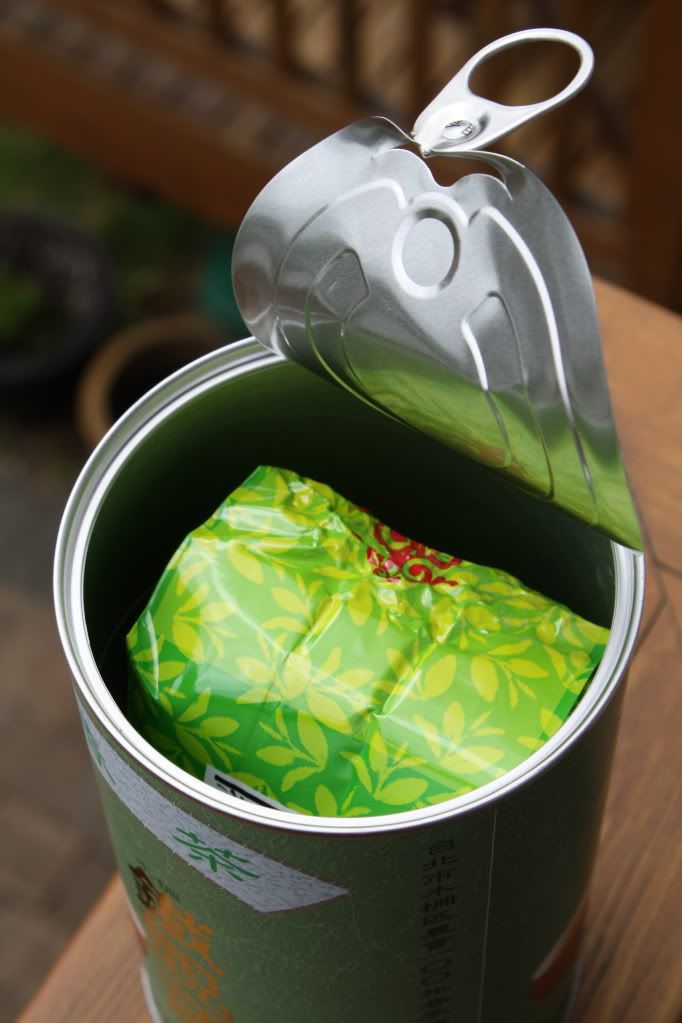
I've tried a handful of different competition teas in my time and have genuinely liked a few.  When I saw Hou De carrying a competition awarded Muzha Tieguanyin I decided to take the plunge and buy a can, partly just so I could say I bought a can of competition tea at least once in my life, and partly because a good Muzha Tieguanyin is one of my favorite oolong types.  The competition tea experience is one with a lot of bright packaging designed to make the tea feel more special than your average tea, including a cardboard box with special seal stickers, a can inside the box with a plastic lid and aluminum pop top, and finally a vacuum-sealed polyfoil bag (how we're used to having our tea packaged).  Naturally, the can is mostly for show, but I've been keeping the bag of tea inside it, at least until the bag gets disproportionately small for the container.

 
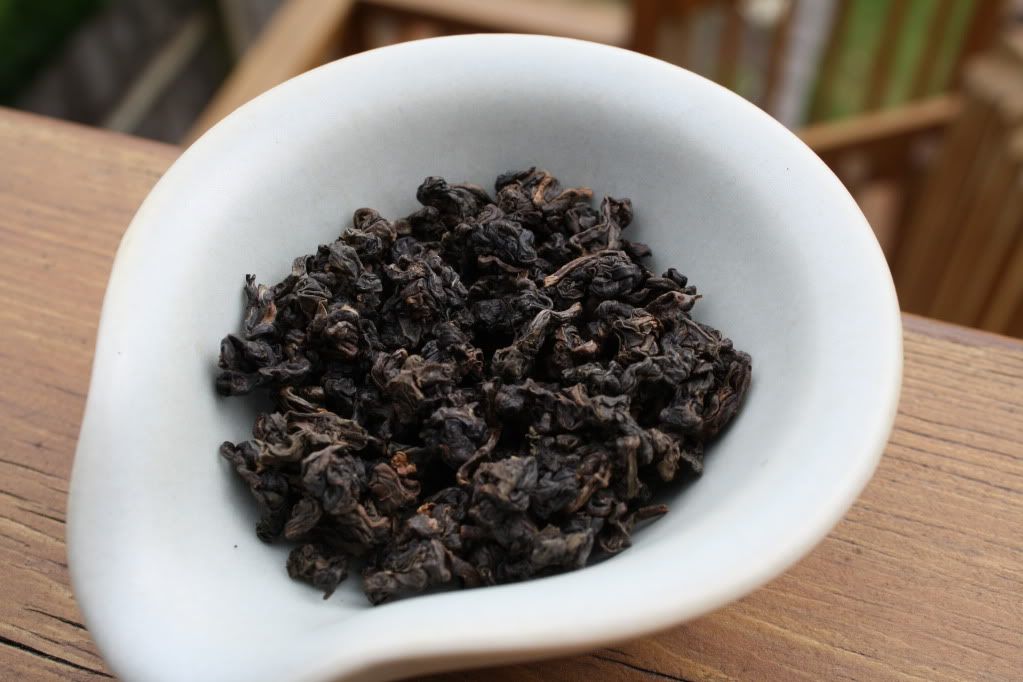
On to the tea.  A few of the competition teas I've had were de-stemmed, supposedly in order to maintain consistency for the competition.  Not the case for this tea, which appears pretty standard for Muzha Tieguanyin--dark, with a few deep green and red notes with stems that take on a somewhat golden hue.  What I was most interested about with this tea is the roasting level--how it would compare to the other Muzha Tieguanyin I've had, which at best seem to balance a dryness with lasting high notes and a solid roasted bottom.  Maybe it's not a surprise, but this competition tea, though well-roasted, doesn't have a strong roasting flavor--that would probably be deemed a flaw by most judges.  Interestingly, the most noticeably excellent trait I notice is the mouthfeel, which is thick and mouth-coating, much heavier than the dryness I usually associate with this tea.  The flavor, likewise, displays only hints of (what has been, to me) the region's particular high note, instead existing in more of a juicy realm of fruity/flowery with a bitter streak that can get out of control without timely brewing attention.  While the tea's profile is striking in the early infusions, I'd say it doesn't last quite as long as some similar dong ding or gaoshan oolong I've had recently.  The tea's creamy body, though unexpected, is really enjoyable and pairs best with one of my red clay pots--the porous ones mute the aroma and somehow promote the bitterness, plus the body's already smooth enough as it is!  Interestingly, pretty much all the Muzha Tieguanyin I've purchased does better in zhuni or hongni.

This tea has disappeared and reappeared on Hou De a few times, and there are only a few ounces left at present.  Since I've got quantity I'll be happy to share a sample with the first whoever leaves the first two comments--international people included!  You'll have to email me your address once you see you've made it.

July 16, 2011

Black Butte Tea

Not the blackest butte I've ever seen.  Please forgive the titular pun.
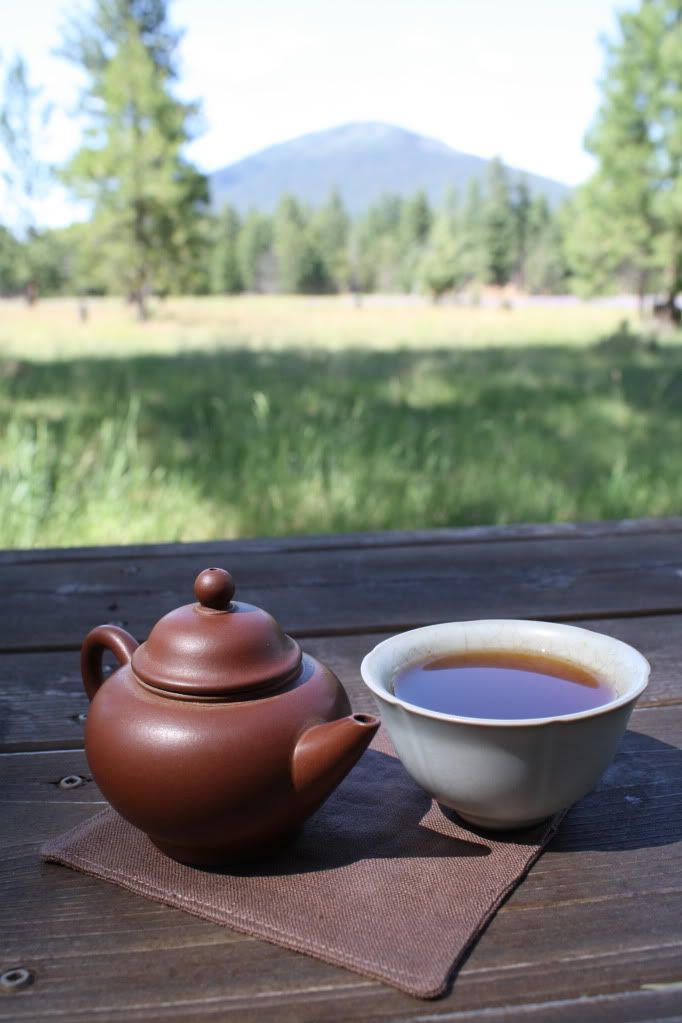
Or, Tea on Vacation Part II.  This past week I've again been fortunate enough to vacation away from home.  This time I've returned to a time-honored summer haunt for my family--Black Butte Ranch in central Oregon.  It's been a great week full of relaxation, physical recreation (including a scenic climb up the pictured butte), productivity (music for a couple of songs and a handful of textual contributions), and--of course--tea drinking!  As I mentioned but didn't document at the time of our last visit, Black Butte is home to a delightful and accessible spring, from which I've been drawing my tea water for the week.

Perhaps unsurprisingly, it's also been a week of numerous minor tea learning experiences at the mild, reflective pace of a good vacation.  Compared with my last trip, I brought almost everything but the kitchen sink (in terms of tea équipage, that is).  The tetsubin, two yixing pots, a gaiwan, and a dozen or so different types of tea.  Lesson #1: Even on a "fully-equipped" vacation, it's probably still smartest to focus on one tea type, because you probably won't make full use of all the different teas you brought, and you get the benefit of close comparison between different teas of the same genre.  Although I made green tea and a delicious Dong-Ding, I mostly drank aged pu-erh.  If I had left the other teas at home, I could have left the gaiwan and one of the pots, not to mention the tea storage space--ah, the joys of over-packing to avoid silly fear of "not enough variety." 

It was a pretty decadent week, since I usually only drink an aged pu-erh every couple of weeks, but all of the repetition was illuminating.  Firstly, a muted session with an '80's shou/sheng brick reminded me that different weather conditions (it's quite dry here) can affect my sensory faculties and, perhaps, the performance of the tea leaves themselves.  Secondly, the failure of an extremely tight chunk of '80's tuo to fully unfurl reminded me that breaking up large chunks (as gently and possible, even if it's difficult) greatly improves the quality of the session--you don't have to separate individual leaves, but getting the chunk into quarters is significant.  Thirdly, a sublime one-off session with my 1993 7542 reminded me how not all sessions with a single tea are created equal and that there's no shame in the notion that a certain chunk of the cake might be contain a just right combination of leaves, while others may not (Lessons #2-4, respectively).

The final learning experience relates to perspective.  Two years ago--drinking many of the same teas I drank this week, incidentally--I was deliriously eager to try my tetsubin and teas out with mountain spring water.  With a couple more years' experience under my belt, my attitudes to spring water and tea preparation in general have mellowed quite a bit.  Whether it's my rustic palate or my lackadaisical approach, the difference between filtered/Lynnwood spring/Black Butte spring water is not especially apparent to me.  Maybe with some close attention I could tell a difference, but that might spoil the relaxation!  Probably the most enjoyable part of making tea with this spring water is retrieving it--it's really enjoyable to collect the fresh, cold water straight out of the earth and reflect on and feel connected to the elements that come together for a good tea session (definitely nowhere close to the extent that those who are attentive to Chinese elemental tradition do, though).  The water tastes amazing right out of the ground--perfectly cold for a hot day after the bike ride to the spring.  It's also interesting to note that, two years after acquiring the tetsubin and using it with spring water, it still hasn't developed much of a mineral scale/patina at all.  I was really nervous when I first noticed the patina was receding, but now I'm little less anxious; the thing still makes good tea water, and preferable to my other kettles--even to my simpleton's palate.  If anything, I'm wondering whether or not it's really necessary to drive up to Lynnwood to regularly collect water, since the patina hasn't returned.  We'll see after I use up the 10 gallons of water I'm bringing back with me.

Where'd that come from?

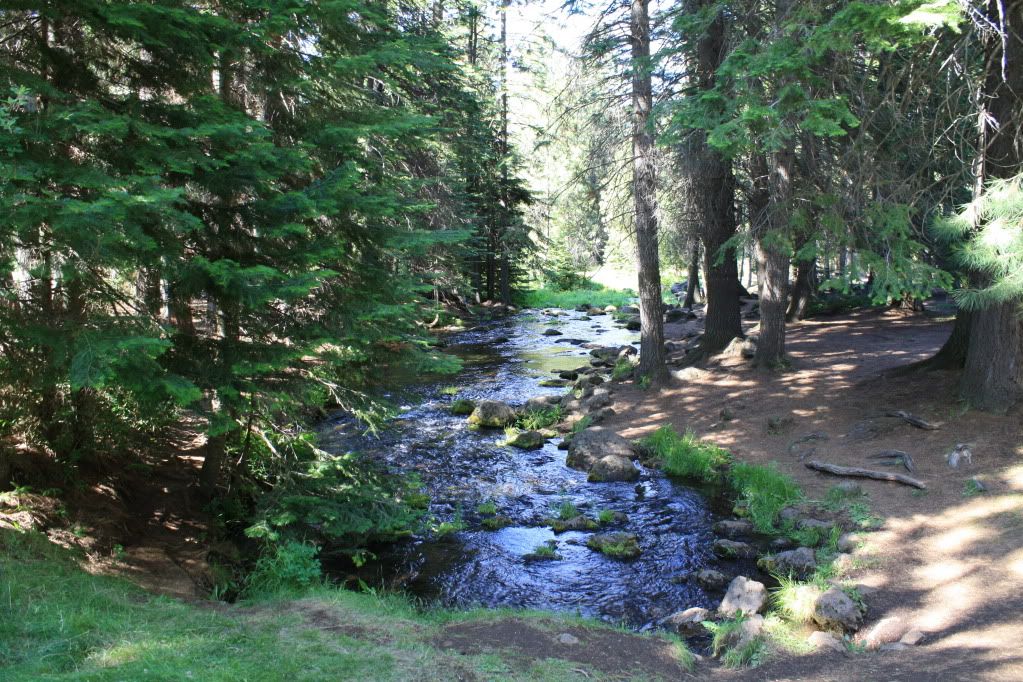
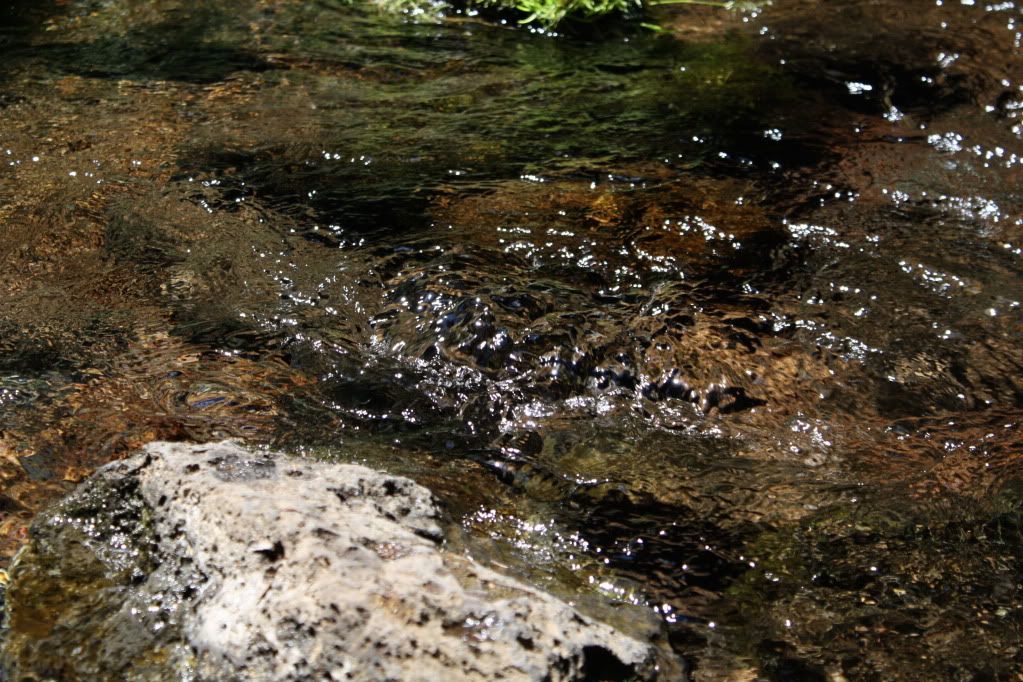
The spring is a great spot--issuing straight out of the ground below where I stood to take this photo and running across the ranch.  There's also a stone bench--a great spot to sit and read, write or quietly enjoy the babbling stream, insects, rodents, birds and wind through the pines.

Water mushrooms.

Unlike the Lynnwood spring, which is technically an "artesian well" (meaning that it was originally human-drilled and since then produces water without pumping), this is an honest-to-goodness spring, bubbling straight out of the ground.  While not quite as convenient for jug-filling, it's an invigorating sight to behold.  Here's to drinking tea in the aid of relaxation and contemplation, and to continually learning about it without getting too scientific!

June 20, 2011

2011 Long jing

It's once again green tea time.  As I've mentioned in past spring posts, I really look forward to drinking Chinese greens while they're fresh from the recent harvest.  This year I've been drinking more than ever--mostly from two of my usual suspects in Jing Tea Shop and Teaspring.  Today I decided to sit down and try the two long jing I purchased this spring for the sake of comparison.


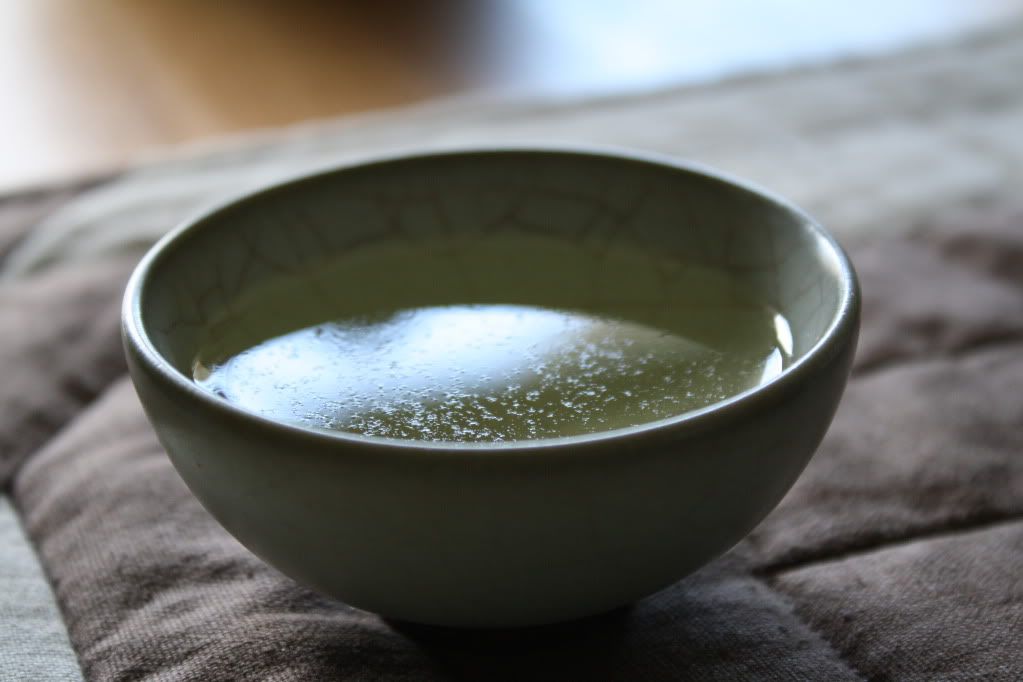
I've been brewing my teas pretty casually this spring--bring the water to a boil, then fill my celadon fair cup with water.  When it's cooled down to the proper temperature (sometimes I'll pour it back and forth between a second fair cup and the cup I'll be using) I'll start steeping the tea, topping the cool water fair cup from the kettle's hotter water with each infusion. After I decant the tea into the second fair cup, I'll pour about half of it into the drinking cup, mixing the next infusion with the remainder, and so on.  While this method hardly allows for scientific scrutiny of each infusion, that's not what I'm really looking for and the overall session tends to produce a more consistent standard of quality from each cup.

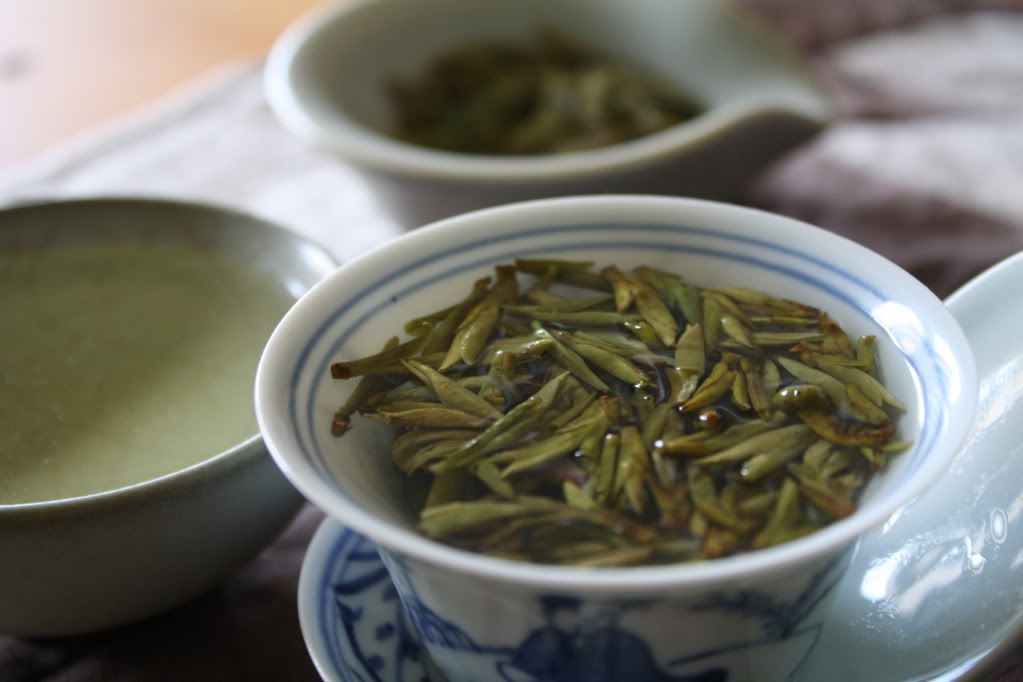
That's some hairy tea.
So, that's how I brewed my dragonwell today.  First, Teaspring's Emperor Long Jing and second, Jing's Shi Feng Long Jing.  I get the impression from reading the notes that Jing's tea is a bit more on the hand-selected side, but who knows for sure?  Both sites have offered teas that I've enjoyed for the last four years or so, and I usually have very few objections.  To my surprise (I thought Jing's would be better), they're both pretty good long jing--but different.  The Emperor example is more up-front, with a more robust body, a bolder flavor and more of the chestnut notes people usually associate with long jing.  The Shi Feng example, though, is subtler, with a lot of sweetness but less of a bold body.  It reveals its character in the aftertaste rather than immediately, and develops more of a vegetal flavor throughout the infusions, even appearing greener to the eye after the session ends.  As usual, I'm glad I tried both teas together, because I likely wouldn't have picked up on the differences trying them days apart. 

Somewhat on the subject, I just added an Eilong studio gaiwan to the Teaware For Sale page.

June 17, 2011

A Teapot


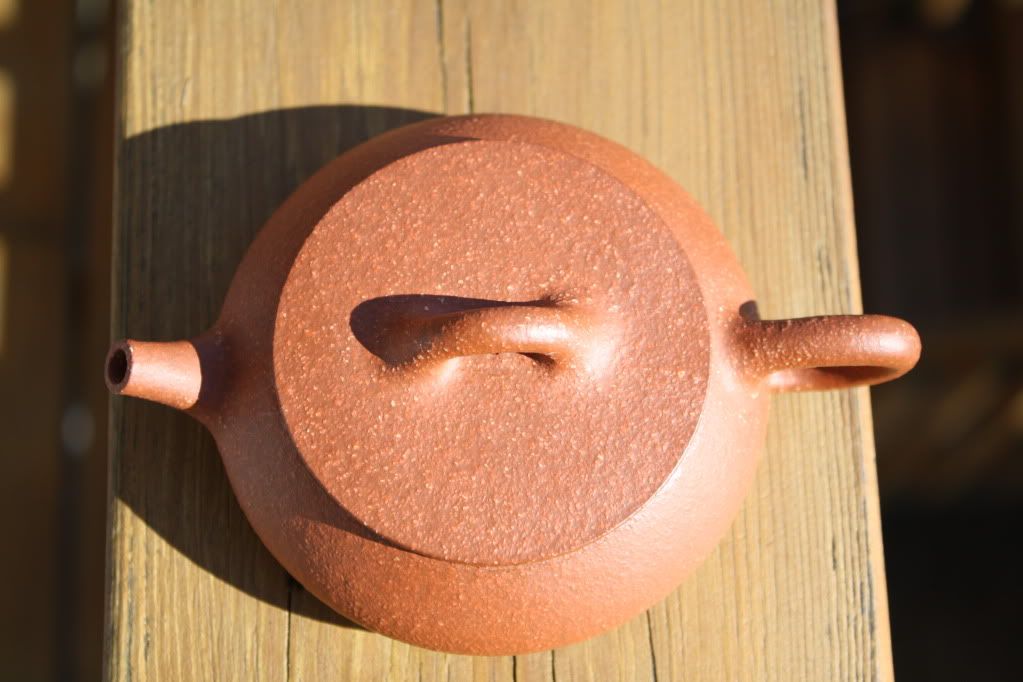
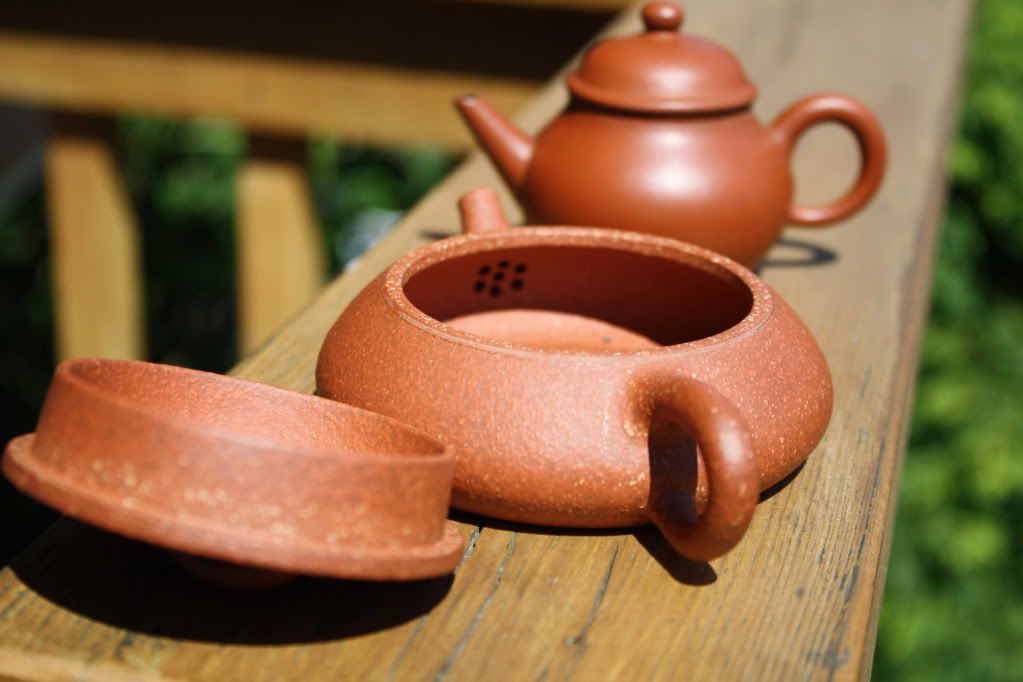
Nothing too exciting happening today--just sharing a relatively recent and strange Yixing purchase and some thoughts on Yixing in general.  I've coveted a nice, classic shi piao teapot for a while, since the ones I've owned so far haven't really worked out (too big or just not good enough).  It's a classic shape that I find attractive in a lot of ways--the unassuming-yet-jollily-angled spout, the graceful lid handle, the characteristic shape of the pot handle, and the generally solid performance pouring and accommodating most tea types.  So, I purchased this one from Jing Tea Shop, which, incidentally just listed a handful of nice-looking xiao pin teapots for those in "need."   At 120ml it's a little larger than my ideal size (usually around 100ml) but I enjoy having a slightly larger pot around, and you don't always have to fill the thing completely full.  When the pot arrived, though, I was quite surprised--thought the listing described the pot as "flat," the pictures couldn't quite capture just how smooshed this pot actually is--it's like somebody squashed it before it was fired, and the main body is barely over an inch tall (for comparison you can see my tiny 70ml hong ni dancong pot, which looks immensely tall in comparison).


Consequently, the pot is quite wide (probably about four inches) for its volume.  Also interesting is the clay, which is described as "Cu Sha Hong Pin Zi Ni."  "Cu Sha" is straightforward--there are some pretty knobbly sand grains blended into the clay, but "Hong Pin Zi Ni" is something I haven't heard of before--pin zi ni is a general term to describe a blend of different zi ni clays, so there can be a pretty broad spectrum of different appearances between different clays labeled as pin zi ni.  But the "hong" is a strange addition--is this pin zi ni blended with hong ni?  Or is there a type of clay that somehow qualifies as zi ni that's actually red?  The answers to these questions sit firmly in the "hell if I know" category.  The origin of the clay's blending aside, it's pretty cool-looking.  The picture below probably best displays the simultaneous visibility of both red, more traditionally brown pin zi ni, and the sand in spite of the bright conditions caused by the "hot" Seattle sun (hey, I'm not complaining). 


Despite how unusual it is, this pot actually works quite well--obviously the lid opening is huge, so it's quite easy to get the leaves in and out, and the pour is much smoother than I expected--a lot of times weirdly-shaped pots don't perform very well.  Another thing I've noticed using this slightly larger pot is that the traditional "rules" about tea-type-to-pot-shape pairing become less and less important the larger the pot is--if this shi piao were 80ml, it would be quite ill-sized for brewing pellet rolled oolongs, as the tea wouldn't have the proper space and shaped area in which to expand.  A bit larger, though, and there's plenty of room, so the pot can be used with really just about any kind of tea, though I'm sure some work better than others with the unusual clay.  I've only been using the pot occasionally to brew mostly steeped-out teas or a weak pot with just a few leaves, so I haven't been too picky about what goes in there.  Works for me.

June 4, 2011

1990's Small Yellow Label CNNP 7532

It's been a while since I promised Matt a post about this tea--partly because Seattle's weather has been pathetically uncooperative for tea photo shoots.  Anyone who's followed the online pu-erh market for any length of time has surely noticed the most recent surge in prices of both aged and young pu-erh.  Unsurprisingly, a lot of us have felt a bit alarmed and have made attempts to nab up a few teas before their prices reach unpurchaseable levels--nothing like a good old market panic to drive the prices up even more.  Having avoided buying much aged pu-erh for a while, I decided to join in the frenzy and purchase some teas I'd been eying for a while.  Like most of the aged pu-erh I tend to post about, this tea comes from Essence of Tea, which means that the strength of the British Pound Sterling versus the US Dollar is an additional factor.  Thankfully it's been pretty stable around $1.60-$1.65 as of late--about average for the last few years, but thankfully nowhere near the $2ish levels it reached around '06.  I suppose the point is that, for once, I actually planned a bit before plunging into this purchase.

Let's find out: One, two, three...three.

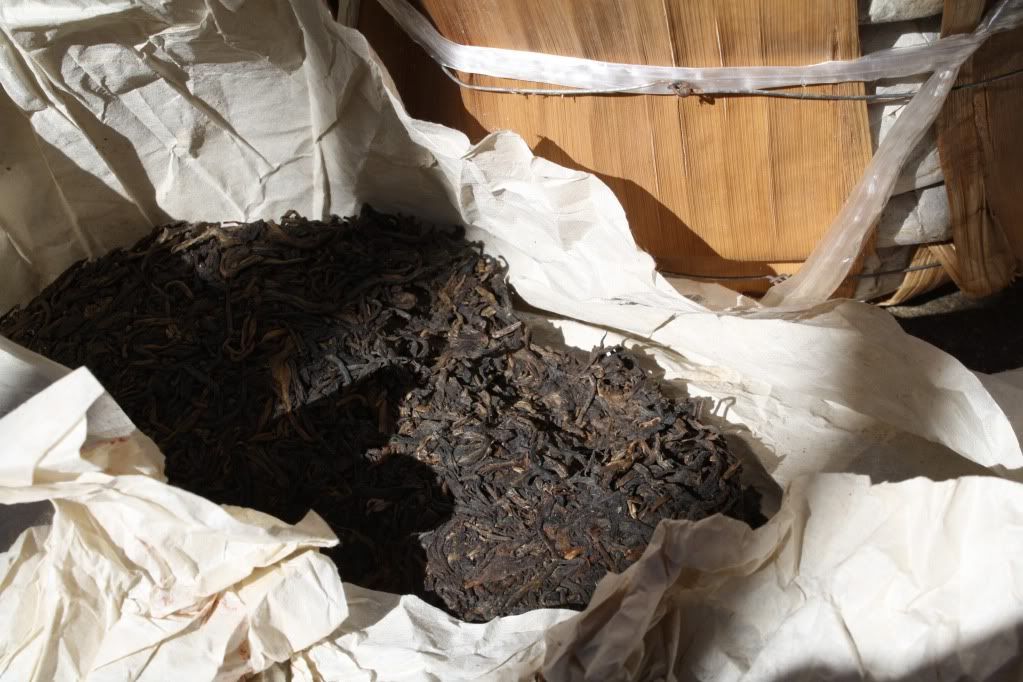
So, this is only the second full tong of pu-erh I've ever purchased.  What was the first, you ask?  Back in 2007 when I knew very little about pu-erh I bought a tong of this tea on sale from Royal Puer in celebration of the shop's first anniversary, thinking it'd be good to have a large amount of "some pu-erh," as if all pu-erh is pretty much the same.  Talk about falling down the rabbit hole.  For the foolish but fairly inexpensive $70 investment, it's a pu-erh of acceptable quality, though I have my doubts as to how well it'll age starting from complete immaturity in the Pacific Northwest.  My main regret is the fact that I ripped the bamboo wrapper completely off right after receiving the tea and the cakes have been loose ever since.  With my most recent tong purchase, my past mistake resulted in behavior of a polar opposite nature--perverse neurosis.  So obsessed with keeping the tong whole for who knows how long, I decided I needed to buy one more cake to work on in the meantime.  Perverse neurosis. 

Oh no, almost gone!  Better buy another cake so I don't have to break into the tong!
Now that I've so greedily hoarded a substantial stash of this tea, perhaps it'd be a good time to try it for the first time?  Joking!  Only joking--I tried numerous samples of this tea before making the purchase.  What do I look like, 2007 me?  This 90's cake is by no means an exceptional aged pu-erh.  Like very few aged pu-erhs, though, it actually inhabits a sweet spot of agedness, quality and price I like to call "value."  Since the tea's only labeled "90's," I assume it's toward the late end of the decade.  If considered as a twelve-year-old aged tea, it's remarkably mature (even for a tea from the mid- or early-90's, I'd say).  There's very little in the way of astringency remaining, the liquor is quite dark and it's only bitter if egregiously oversteeped or too many leaves are used.  I can only assume that it's gone through some fairly humid storage, though the cake surface is really quite clean and mold-free.  There is, however, an attractive staining of the wrapper and tickets that would indicate a bit of humidity, juiciness or both.

 Flavor-wise, it's no paragon of complexity--the notes are mostly what I'd expect from my past experiences with 90s CNNP--standard pu-erh plus a solid dose of sticky huang pian sweetness.  There's plenty of humidity and earth in the flavor to corroborate the other evidence, but this tea's storage is by no means as tough to handle as the stomach-churning (for me, anyway) Hong Kong storage of its similarly-priced EoT brethren, the Late 90's Grand Yellow Label.  There's no sparkling complexity that can be found in more special aged sheng, but it's a far cry from the one-dimensionality often exhibited by aged loose teas, for example, providing a handful of simultaneous flavor and mouthfeel experiences and a noticeable progression during a long brewing session.  This is a tea I thoroughly enjoy drinking now and will be happy to continue drinking whether or not its aging progresses, which gets at the primary motivation behind this purchase. 

I find myself less and less often looking for amazing, unparalleled examples of a certain type of tea, but more often for good, solid examples that are "the way I like it" and can be enjoyed repeatedly without the stress of budgeting a tiny quantity.  Not that I don't appreciate amazing tea, but I can't afford a ton of it and tea drinking is such a part of my lifestyle that I can't always pay the kind of attention that extremely expensive, good tea deserves.  This tea fits bill, and after buying so much of it I can virtually drink as much as I want without any fear of running out before finding out whether or not it's continued aging.  Also importantly, if I simply feel like casually drinking "some pu-erh" I can turn to this tea instead of a much more expensive one, thereby making my more modest stocks of those teas last much longer.  In the months since I special ordered my tong I see the full cakes have sold out.  I'm hoping David and Kathy restock this tea soon, as I feel it's probably the best value for its agedness on the Western-oriented web--what an affordable way to learn about aged pu-erh!  At roughly $90 for a cake, this tea is priced below innumerable cakes of 2005 or later vintage that provide no insight into the experience of drinking aged pu-erh, an experience I feel is usually unjustifiably difficult and expensive to achieve in the Western tea drinking world.